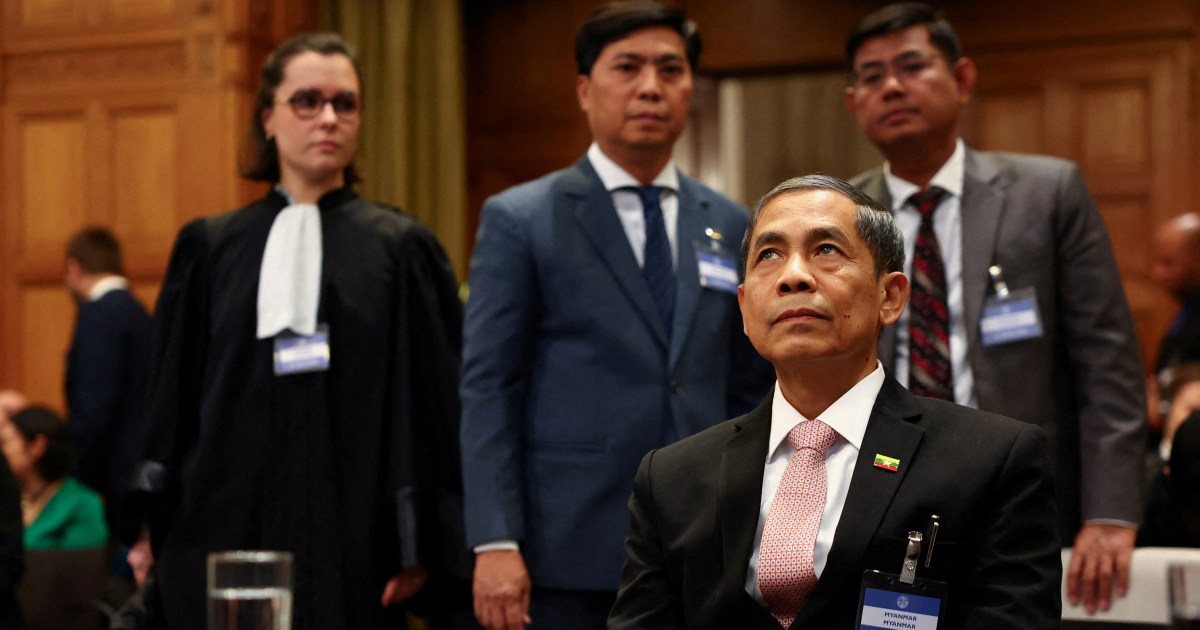

An international court case accusing Myanmar of committing genocide against its mostly Muslim Rohingya minority is “flawed and unfounded”, the country’s Ministry of Foreign Affairs says.
In a statement published by state media on Wednesday, Myanmar’s military government hit out at the genocide case, which has been brought to the International Court of Justice (ICJ) in The Hague, Netherlands, by The Gambia.
- list 1 of 3Why is Bangladesh saying it can no longer host Rohingya?
- list 2 of 3US aid cuts force Rohingya girls into marriage, children into hard labour
- list 3 of 3Video: What do Rohingya refugees think about Myanmar’s election?
end of list
“The allegations made by The Gambia are flawed and unfounded in fact and law,” the Foreign Ministry said.
“Biased reports, based on unreliable evidence, cannot make up for truth,” it said.
Myanmar’s military rulers, who seized power in 2021, are cooperating with the ICJ case “in good faith” in a sign of respect for international law, the statement added.
The Gambia filed the case against Myanmar at the ICJ, also known as the World Court, in 2019, two years after the country’s military launched an offensive that forced about 750,000 Rohingya from their homes, mostly into neighbouring Bangladesh.
Survivors of the military operation recounted mass killings, rapes and arson attacks. Today, about 1.17 million Rohingya live crammed into dilapidated refugee camps in Cox’s Bazar in Bangladesh.
On the opening day of the trial on Monday, Gambian Justice Minister Dawda Jallow told the court the Rohingya “have been targeted for destruction” in Myanmar.
Lawyers for military-ruled Myanmar will begin their court response on Friday.
The trial is the first genocide case the ICJ has taken up in full in more than a decade, and its outcome will have repercussions beyond Myanmar, likely affecting South Africa’s petition against Israel over its genocidal war in Gaza. The hearings will span three weeks.
Advertisement
The human rights chief of the United Nations at the time of the crackdown in Myanmar called it a “textbook example of ethnic cleansing”, and a UN fact-finding mission concluded that the military’s 2017 offensive had included “genocidal acts”. But authorities in Myanmar rejected the report, claiming its military offensive was a legitimate counterterrorism campaign in response to attacks by Rohingya armed groups.
Wednesday’s statement by Myanmar’s Foreign Ministry did not use the word Rohingya, instead referring to “persons from Rakhine state”.
The Rohingya are not recognised as an official minority in Myanmar, which denies them citizenship despite many having roots in the country stretching back centuries.
A final decision in the Rohingya genocide case could take months or even years, and while the ICJ has no means of enforcing its decisions, a ruling in favour of The Gambia would likely place more political pressure on Myanmar.
The Southeast Asian nation is currently holding phased elections that have been criticised by the UN, some Western countries and human rights groups as neither free nor fair.
Related News
Iran’s judiciary to speed up trials of accused in protests crackdown
US revokes more than 100,000 visas since Trump’s return to office
Democrats slam ‘illegal’ US attack on Venezuela, ‘capture’ of Maduro