
Prison rights, Elbit’s loss: How the Palestine Action hunger strike ‘won’
 16 January 2026
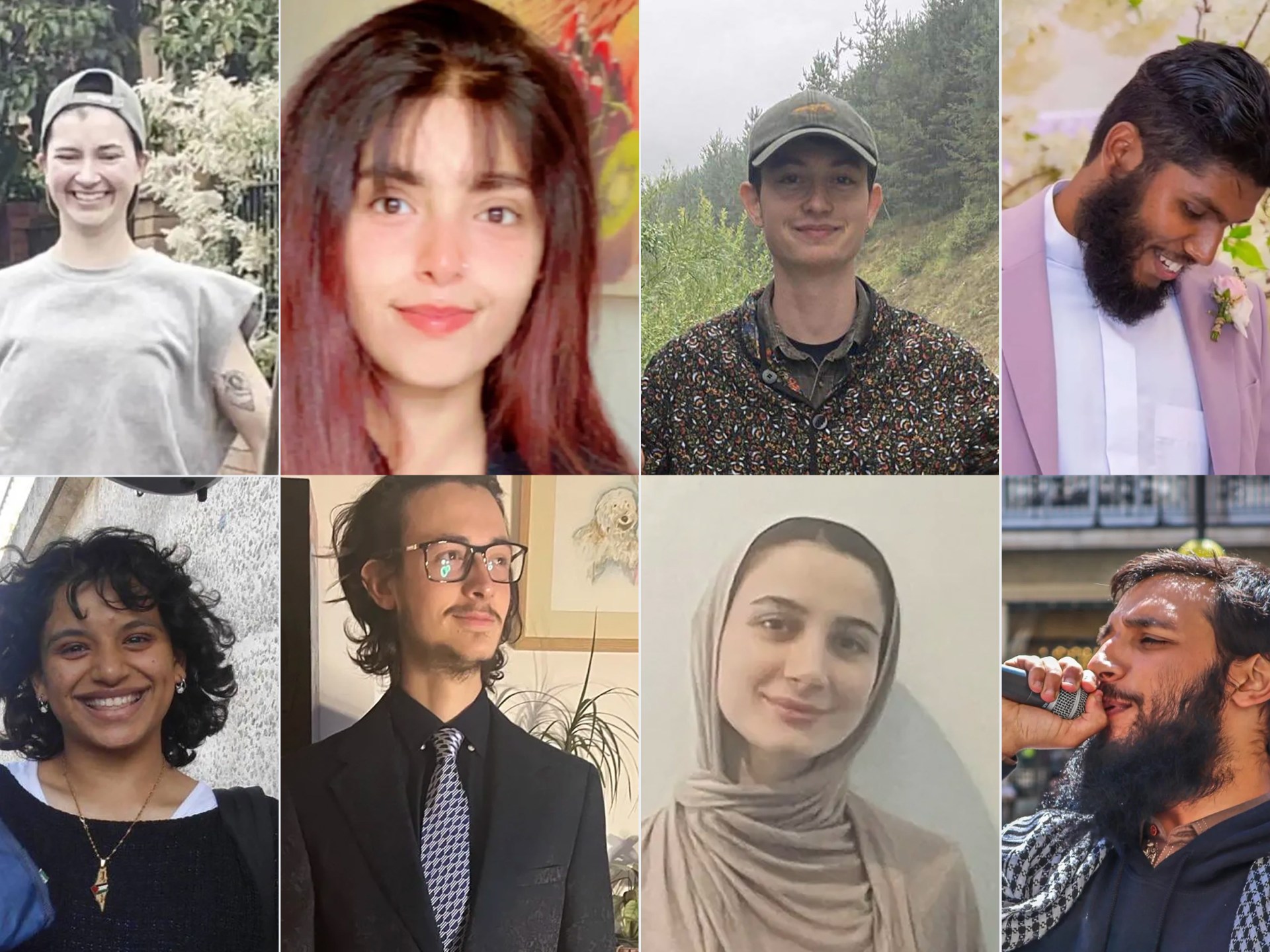

London, United Kingdom – In the final days of their months-long hunger strike, three young pro-Palestine activists on remand – convicted of no crime – were confronted with their mortality in the confines of their prison cells.
Heba Muraisi, 31, who refused food for 73 days, was suffering with a level of pain so severe that sitting felt unbearable. At 49kg (108lb), her body wasting away, there were fears her organs were shutting down. Her memory declined and she had muscle spasms, a sign of possible neurological damage.
- list 1 of 4Hunger strike for 70 days: How the body breaks down without food
- list 2 of 4The UK is taking political prisoners to evade accountability for genocide
- list 3 of 4Writers declare solidarity with prisoners on hunger strike for Palestine
- list 4 of 4Three Palestine Action activists end UK hunger strike
end of list
But until they announced the end of their hunger strikes on Wednesday amid their rapidly collapsing health, Muraisi and prisoners Kamran Ahmed, 28, and Lewie Chiaramello, 23, were determined to continue.
A Londoner who worked as a florist and lifeguard, Muraisi told Al Jazeera this week that she had resigned herself to the idea of death but wanted to keep refusing food in protest because she was “finally being heard”.
Ahmed, in a statement sent to Al Jazeera, has said ending the hunger strike after 65 days felt “bittersweet”.
Chiaramello had fasted every other day, as he is a Type 1 diabetic, for 46 days.
‘I was willing to go the distance’
In total, eight individuals have participated in the protest since early November. Currently, just one remand prisoner, Umer Khalid, continues to refuse food.
“I was willing to go the distance,” said Ahmed, who is also from London and had worked as a mechanic. “But others were not willing to see me walk a mile further.”
Described by loved ones as having become paper-thin, Ahmed has lost 25 percent of his body weight. His heart muscle has shrunk, he suffers from chest pains and has lost hearing in one ear. His speech was slurring, and walking took so much energy it made him breathless.
Advertisement
On Monday, when they last spoke by phone, his sister Shahmina Alam, a pharmacist, urged him to consider ending the strike.
“We just knew that it’s coming to a point where it’s really dangerous and actually, the probability of death was very high,” she told Al Jazeera.
Alam and physicians consulting the group are concerned that the hunger strikers may have already suffered irreversible health damage, as long-term symptoms related to starvation can take years to show. There are also fears around refeeding, which can be fatal if mismanaged.
Ahmed was hospitalised again this week, the seventh time since the protest began.
The collective held at various prisons includes Qesser Zuhrah; Amu Gib; Muraisi; Teuta Hoxha; Ahmed; Chiaramello; Jon Cink and Khalid, who has muscular dystrophy and has been on hunger strike for seven days.
All will have spent more than a year in prison before their trials are expected to take place later this year, far beyond the standard six-month pre-trial detention limit.
Some of the group, known as part of the “Filton 24”, are alleged to have participated in a break-in at the UK subsidiary of Israel’s largest arms manufacturer, Elbit Systems, in Bristol. Others are accused of involvement in a break-in at a Royal Air Force (RAF) base in Oxfordshire. They deny the charges against them, such as burglary and criminal damage.
Palestine Action, the group they are allegedly linked to, claimed responsibility for both incidents.
Six of those charged in the Bristol action are currently on trial.
Were the hunger strikers’ demands met?
The collective had five key protest demands, including immediate bail, the guarantee of a fair trial and the de-proscription of Palestine Action.
They also called for all 16 of Elbit’s sites in the UK to be closed and demanded an end to what they call censorship in prison, accusing authorities of withholding mail, calls and books.
Throughout the protest, the government said the group would face a fair trial, that it had no power over the issue of bail, as this is a matter for the judiciary, and that prison welfare procedures were being followed. It has not commented on the end of the latest hunger strikes.
Elbit Systems, a target of Palestine Action’s campaign, describes its drones, which have been used extensively in Gaza to deadly effect, as “the backbone” of Israel’s drone fleet.
Palestine Action had been calling to “shut Elbit down” before it was outlawed as a “terrorist organisation” in July, putting it on par with ISIL (ISIS) and al-Qaeda. The group, which said it backed direct action without violence and accused the UK of complicity in Israel’s atrocities, is fighting the ban in courts.
Advertisement
In the later stages of the hunger strike, the group added a further demand – that Muraisi be returned to Bronzefield prison near her home, having been moved to a jail in northern England.
That will now happen, said Prisoners for Palestine, an activist-led group that supports the collective’s families, hailing the transfer as a triumph.
Prisoners for Palestine has claimed several “victories” – primarily the UK government’s recent decision, reported by The Times newspaper, against awarding Elbit Systems UK a 2-billion-pound ($2.68bn) army training contract. However, the contract is instead reportedly going to Raytheon UK, the subsidiary of the US defence firm, which also has several deals with the Israeli military. Back in October 2023, Raytheon’s CEO said the company would “benefit” as the “war in Gaza or in Israel … will eventually lead to additional orders”.
“Obviously we will never know – and I don’t think they’ll ever admit – how much of an influence the hunger strike had on [the contract decision against Elbit],” Alam, Ahmed’s sister, said.
“There were some wins,” she added, such as raising awareness about Elbit’s role in Israel’s genocide and the overuse of pre-trial detention in the UK.
‘There has been some concessions by government’: MP
The group’s supporters have also claimed victory.
“There has been some concessions by government,” said John McDonnell, a Labour MP, as he paid tribute to the hunger strikers’ “dedication”.
Prisoners for Palestine said it considers as another success the offer of a meeting between Hoxha and the head of JEXU (Joint Extremism Unit) at her prison. Hoxha had claimed she was being monitored by the JEXU task force and that it had ordered prison officers to strip her of a library job in jail.
The group also saw as a win its meeting with prison healthcare leaders “at the behest of the Ministry of Justice”, and the “bulk” release of mail it alleged had been “withheld”.
“Books on topics of Gaza and feminism have also been given [to the prisoners] after months of waiting,” the group said.
The protest is said to have been the largest coordinated hunger strike in UK history since 1981, when Irish Republican inmates were led by Bobby Sands. Sands died on the 66th day of his protest, becoming a symbol of the Irish Republican cause. Nine others also died of starvation.
“Our prisoners’ hunger strike will be remembered as a landmark moment of pure defiance; an embarrassment for the British state,” said Prisoners for Palestine, which offers “direct action training” on its website.
“While these prisoners end their hunger strike, the resistance has just begun,” said the group, adding that 500 people have recently expressed interest in taking “direct action against the genocidal military-industrial complex”.
It added that in pursuit of a fair trial, the hunger strikers had demanded the disclosure of export licences for the last five years from Elbit Systems. “After repeated requests, this information was disclosed to an independent researcher by the Department of Trade during the hunger strike,” it said, hailing another “victory”.
Advertisement
Alam said she imagines Ahmed will have had a few cups of tea since the hunger strike ended. He requested soya milk, she said, as it is easier on the stomach.
The government does not “get to decide whether these guys live or don’t live”, she said.
“At the end of the day, it’s their decision, and that’s what they did.
“They took back control.”
Related News

Delcy Rodriguez sworn in as Venezuela’s president after Maduro abduction
US-Iran tension lingers as Tehran reopens airspace
Nick Reiner’s lawyer resigns amid court proceedings for Rob Reiner’s murder
