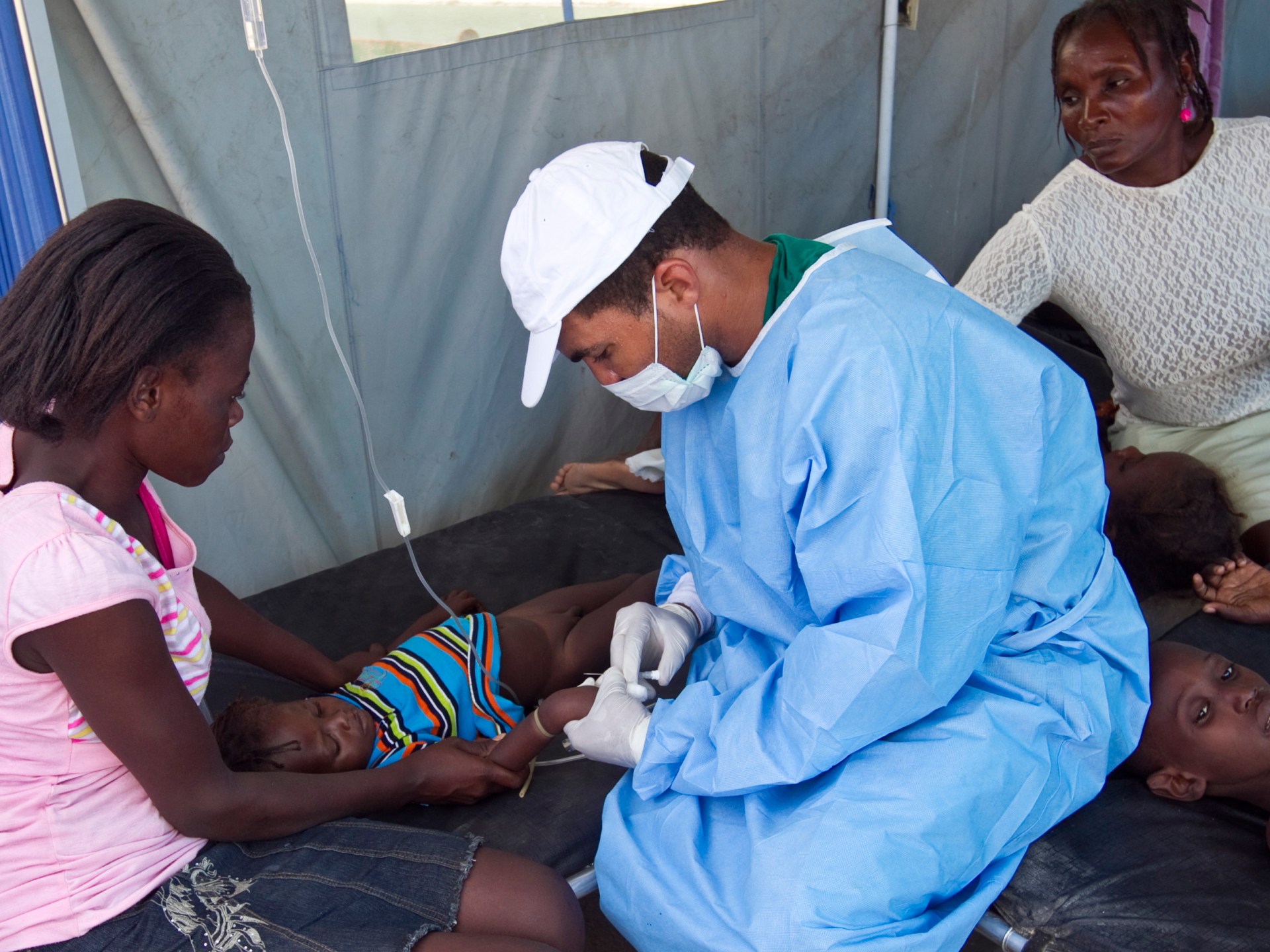

Guatemala announced last week that it will begin phasing out its three-decade-old programme, under which Cuban doctors work in its country to fill the gap in the country’s healthcare system.
Communist-ruled Cuba, under heavy United States sanctions, has been earning billions of dollars each year by leasing thousands of members of its “white coat army” to countries around the world, especially in Latin America. Havana has used its medical missions worldwide as a tool for international diplomacy.
- list 1 of 4Trump says planning to ‘make visit’ to Venezuela following Maduro abduction
- list 2 of 4Fire at Havana oil refinery as Cuba’s fuel crisis deepens
- list 3 of 4Waste piles up in Cuba as US-imposed fuel blockade halts collection trucks
- list 4 of 4Washington appoints new US envoy on Tibetan human rights
end of list
So why are some countries withdrawing from the programme that helps the host countries?
Why is Guatemala phasing out Cuban doctors?
Guatemala’s health ministry said in a statement that it would begin a “gradual termination” over this year.
“The phased withdrawal of the Cuban Medical Brigade stems from an analysis of the mission’s completion of its cycles,” the statement, originally in Spanish, said on February 13.
The statement added that the Cuban medical mission was meant to support Guatemala through the 1998 Hurricane Mitch, which devastated parts of Central America, overwhelmed local hospitals and left rural communities with almost no access to medical care.
“The Ministry of Health is developing a phased strategic replacement plan that includes hiring national personnel, strengthening incentives for hard-to-reach positions, strategic redistribution of human resources, and specialized technical support,” the statement said.
The Cuban mission in Guatemala comprises 412 medical workers, including 333 doctors.
Advertisement
The Central American country’s decision comes amid growing pressure from the United States, which wants to stop Cuban doctors from serving abroad.
The move aims to starve Cuba of much-needed revenue as a major share of the incomes earned by doctors goes to government coffers. Cuba has been facing severe power, food and medical shortages amid an oil blockade imposed by the Trump administration since January.
Guatemala is just one country which benefits from Cuban medical missions.
Over the past decades, Cuba has sent medical missions around the world, from Latin America to Africa and beyond. It began sending these missions shortly after the 1959 Cuban revolution brought Fidel Castro to power.
Castro’s communist government reversed many of the pro-business policies of Fulgencio Batista, the dictator backed by the US. The revolution ruptured ties between the two countries, with the US spy agency CIA trying several times unsuccessfully to topple Castro’s government.
Guatemala has moved closer to the US since the election of Bernardo Arevalo as the president in January 2024. He has cooperated with US President Donald Trump’s administration. Last year, Guatemala agreed to ramp up the number of deportation flights it receives from the US. The US has deported thousands of immigrants without following due process to third countries such as Guatemala and El Salvador, which are headed by pro-Trump leaders.
In November 2018, shortly after Brazil elected Jair Bolsonaro as president, Cuba announced its withdrawal from the country’s Cuba “Mais Medicos” (More Doctors) programme. Bolsonaro, who is known as Brazil’s Trump, had criticised the medical mission, deeming it “slave labour”. Bolsonaro is serving a 27-year prison sentence after he was convicted in September 2025 of plotting to stage a coup in order to retain power after his defeat in the 2022 presidential election.
Why is the US targeting Cuba’s global medical missions?
The US has deemed Cuba’s foreign medical missions a form of “forced labour” and human trafficking, without any evidence, and has a goal of restricting the Cuban government’s access to its largest source of foreign income.
US efforts to curb Cuba’s medical missions are not new. Just last year, Washington imposed visa restrictions aimed at discouraging foreign governments from entering into medical cooperation agreements with Cuba.
In February last year, US Secretary of State Marco Rubio announced that the US would restrict visas targeting “forced labor linked to the Cuban labor export program”.
Advertisement
“This expanded policy applies to current or former Cuban government officials, and other individuals, including foreign government officials, who are believed to be responsible for, or involved in, the Cuban labor export program, particularly Cuba’s overseas medical missions,” a statement on the US State Department’s website said.
Rubio, who is of Cuban origin, has been a vocal critic of Havana, and has pushed US policies in Latin America, including the military operation to abduct Venezuelan President Nicolas Maduro on January 3. Under Trump, Washington has pushed its focus on Latin America as part of its Western Hemisphere pivot, which seeks to restore Washington’s preeminence in the region.
Since Maduro’s abduction, the US focus has turned towards Cuba. Senior US officials, particularly Rubio, hinted that Havana could be the next target of Washington’s pressure campaign.
The US, in effect, cut off Venezuelan oil shipments to Cuba as part of a new oil blockade. Havana has faced sweeping US sanctions for decades, and Cuba has since 2000 increasingly relied on Venezuelan oil provided as part of a deal struck with Maduro’s predecessor, Hugo Chavez.
The blockade has caused a fuel shortage and, in turn, a severe energy crisis in Cuba. President Miguel Diaz-Canel has imposed harsh emergency restrictions as a response.
This has renewed US pressure on countries to phase out Cuban medical missions.
How many Cuban doctors are on missions abroad?
More than 24,000 Cuban doctors are working in 56 countries worldwide. This includes Latin American countries such as Venezuela, Nicaragua and Mexico; Africa, including Angola, Mozambique, Algeria; and the Middle East, including Qatar.
There have been occasional deployments in other countries. For instance, Italy received Cuban doctors during the COVID-19 pandemic to help overwhelmed hospitals in some of its hardest-hit regions.
Cuban doctors are crucial for Caribbean countries. They fill a significant gap in medical care amid a lack of trained medical professionals.
Have countries resisted US pressure in the past?
Caribbean countries hit back in March 2025 against the US threats to restrict visas. “We could not get through the pandemic without the Cuban nurses and the Cuban doctors,” Barbados’s Prime Minister Mia Mottley said in a speech to the parliament.
“Out of the blue now, we have been called human traffickers because we hire technical people who we pay top dollar,” Trinidad and Tobago’s Prime Minister Keith Rowley said back then, adding that he was prepared to lose his US visa.
“If the Cubans are not there, we may not be able to run the service,” Saint Vincent and the Grenadines then-Prime Minister Ralph Gonsalves said. “I will prefer to lose my visa than to have 60 poor and working people die.”
In August 2025, the US announced that it was revoking the visas of Brazilian, African and Caribbean officials over their ties to Cuba’s programme that sends doctors abroad.
It named Brazilian Ministry of Health officials, Mozart Julio Tabosa Sales and Alberto Kleiman, who had their visas revoked for working on Brazil’s Mais Medicos, or “More Doctors” programme, which was created in 2013.
Advertisement
Some countries are now finding ways around the pressure from Washington. For instance, this month Guyana announced that it would start paying doctors directly, rather than through the Cuban government.
Related News
Washington appoints new US envoy on Tibetan human rights
Bangladesh votes in first election since 2024 uprising that toppled Hasina
Iran’s top diplomat set to address Al Jazeera Forum in Doha