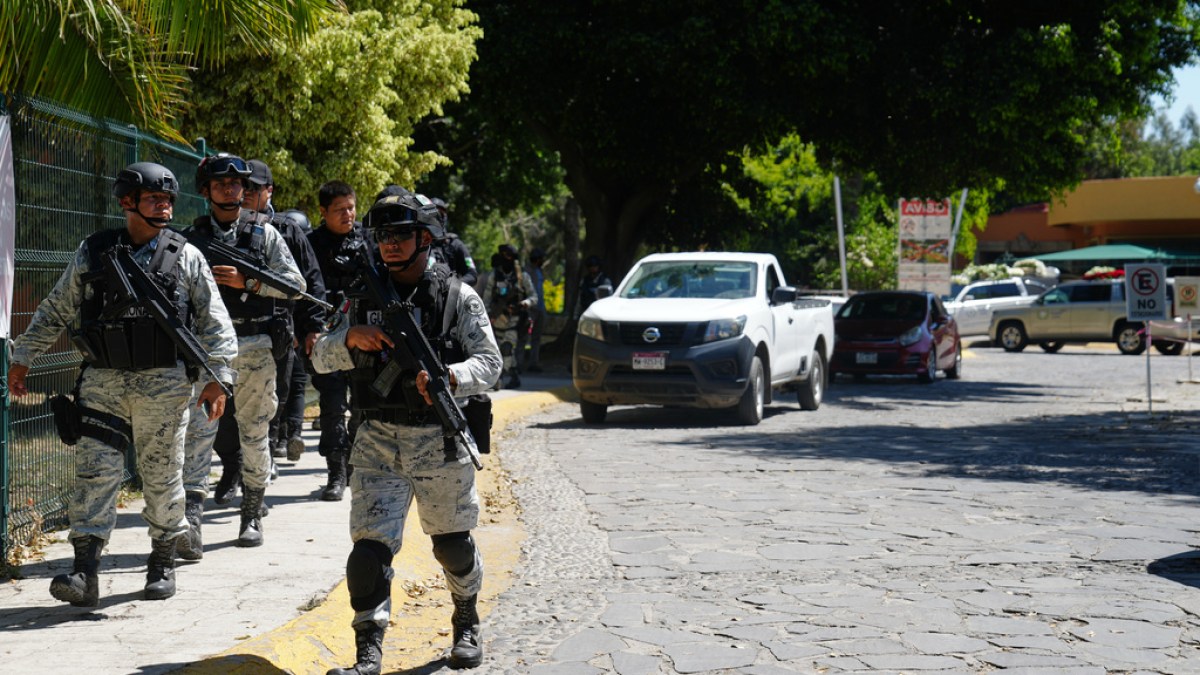

President Claudia Sheinbaum has unveiled a plan to deploy as many as 100,000 members of Mexico’s security forces during the 2026 FIFA World Cup.
Sheinbaum made the announcement during a Friday visit to a suburb of Guadalajara, the capital of Jalisco state.
- list 1 of 3Residents raise alarm as violence-hit Guadalajara to host World Cup games
- list 2 of 3Is the US arming Mexican cartels?
- list 3 of 3Middle East conflict threatens Iraq’s participation in World Cup playoffs
end of list
The area had been struck by a wave of violence after Mexico launched a deadly military operation on February 22 against cartel leader Nemesio “El Mencho” Oseguera, who was killed in an exchange of gunfire.
Sheinbaum used her remarks to reassure the public that Jalisco and the whole of Mexico would be safe, particularly as security concerns ramp up ahead of the World Cup.
“We are here … to tell everyone in Jalisco, all the people of Jalisco, that we are together, that we are working for peace, security and the wellbeing of the inhabitants of this beautiful state,” Sheinbaum said alongside members of her security cabinet.
Mexico is set to host World Cup matches in three cities: Guadalajara, Mexico City and Monterrey. A total of 13 games will be held between the three sites.
But the recent burst of violence has spurred questions about security in Mexico. Officials have sought to assure FIFA authorities and potential travellers that the tournament will be safe.
The World Cup is set to start on June 11, and it is being co-hosted by the United States and Canada as well. The first match kicks off in Mexico City, followed by a second on the same day in Guadalajara.
General Roman Villalvazo Barrios, head of Mexico’s World Cup coordination centre, said that the country’s security plan includes 20,000 military personnel, including National Guard troops, and 55,000 police officers, supplemented by members of private security companies.
Advertisement
“That gives us a total of just over 99,000 personnel,” said Barrios, noting that the government was also coordinating with its co-hosts on security.
“For Mexico, [the World Cup] entails two challenges: to present a reliable and secure country before the international community, and to have the capacity to confront any threats that undermine national security,” Barrios added.
The death of El Mencho last month came as Mexico faces pressure from the US to aggressively confront cartels within its borders.
El Mencho had been a leader in the Jalisco New Generation Cartel (CJNG), and his killing prompted retaliatory attacks across Mexico.
Still, critics have questioned the increasing use of Mexico’s military in law enforcement efforts.
During Sheinbaum’s tenure and that of her predecessor, Andres Manuel Lopez Obrador, Mexican military forces have taken on a greater role in governance and public security, despite concerns from rights groups about corruption and human rights abuses.
Related News
US President Trump promises new tariffs, slams Supreme Court decision
Hong Kong conglomerate says Panama Canal ports seized by authorities
US father found guilty of murder in Apalachee school shooting in Georgia