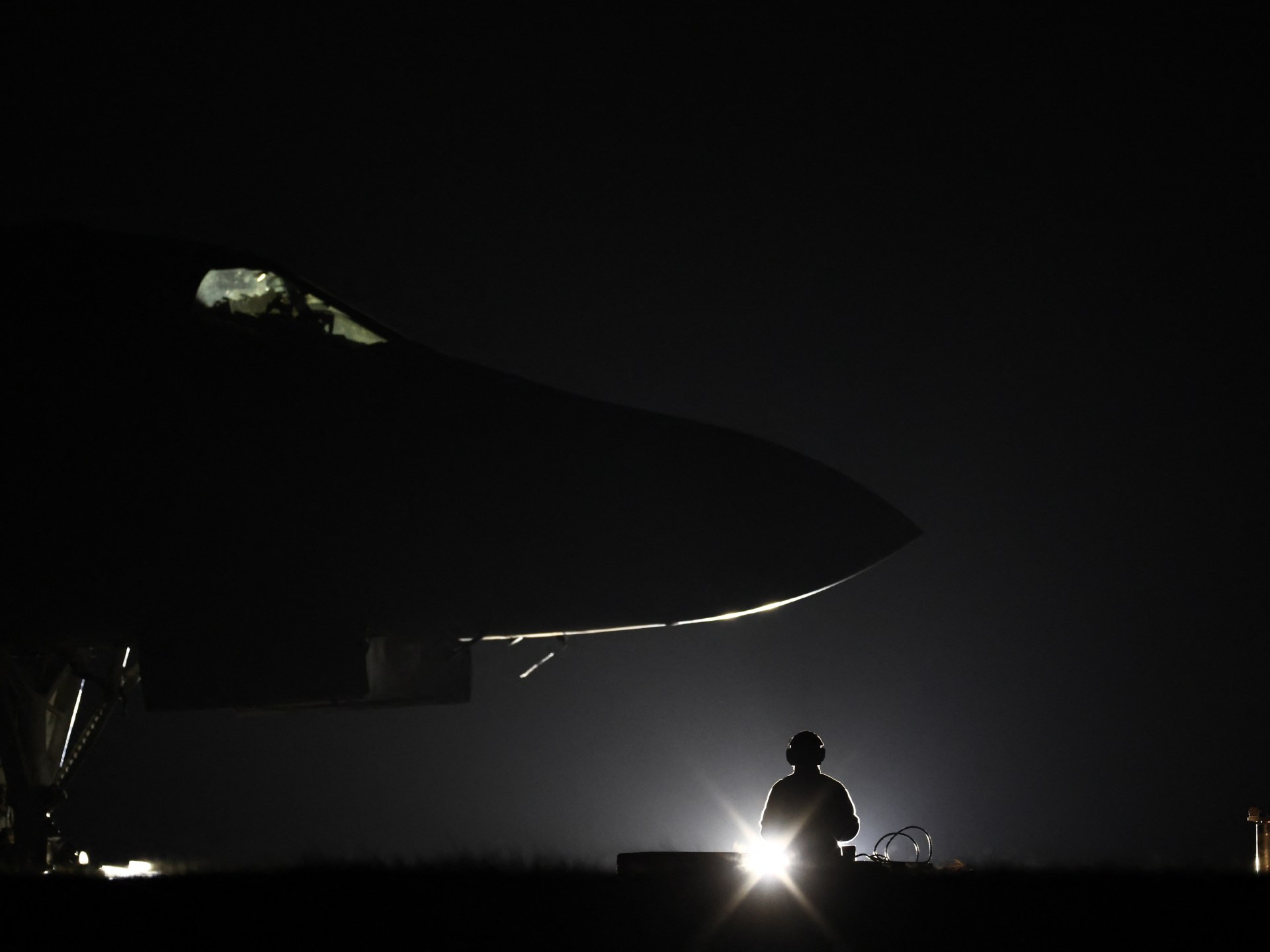

The United States military on Wednesday confirmed the use of multiple artificial intelligence (AI) tools in the ongoing US-Israel war on Iran.
However, the war in Iran is not the first time the US military has relied on tech companies. For decades, tech companies and universities have collaborated with the US military in the development of weapons. For example, the commercial internet originated from a US military-funded project called ARPANET to provide secure communication during the Cold War.
In this explainer, we look at how the Pentagon has historically collaborated with tech firms and how Big Tech companies such as Google, Amazon, Microsoft, Meta and Palantir have increasingly become embedded in the US military.
How is the US using AI in the Iran war?
Brad Cooper, head of US Central Command (CENTCOM), said in a video message: “Our war fighters are leveraging a variety of advanced AI tools. These systems help us sift through vast amounts of data in seconds so our leaders can cut through the noise and make smarter decisions faster than the enemy can react.”
For military and defence use, AI tools, such as LLMs, can summarise large volumes of text, analyse data, translate, transcribe and draft memos. In theory, they can also be used to support autonomous or semi-autonomous weapons systems, which can identify and hit targets without the need for human instruction.
However, most AI companies have terms that prohibit this use.
LLM, or a large language model, is an AI technology that generates text, visual or audio output similar to content created by humans after analysing massive datasets such as books, archives, websites, pictures and videos.
Advertisement
“Humans will always make final decisions on what to shoot and what not to shoot and when to shoot, but advanced AI tools can turn processes that used to take hours and sometimes even days into seconds,” CENTCOM’s Cooper said.
The US military used AI company Anthropic’s Claude in its operations to abduct Venezuelan President Nicolas Maduro on January 3, despite Anthropic’s usage policy forbidding Claude from being used for surveillance, the development of weapons or “inciting violence”.
US media have also reported that Anthropic has partnered with Palantir Technologies, whose tools are also used by the Defense Department and federal law enforcement agencies.
Anthropic was blacklisted by the Pentagon after the company refused the demand to drop AI safeguards, which prevent its technology from being used to conduct US domestic surveillance and to programme autonomous weapons which can hit targets without human intervention.
United Kingdom-based health workers’ organisation Medact has opposed Palantir, which has been tasked to build a Federated Data Platform (FDP) for the National Health Service (NHS) England. Palantir has been criticised for supplying its AI products and services to the Israeli military and intelligence services during the ongoing Gaza genocide. Scholars and campaigners say Israel’s war on Gaza is a genocide.
Earlier this month, ChatGPT’s parent company OpenAI changed its deal with the US government to explicitly bar it from spying on Americans after facing similar backlash.
Is the US military the only one to do this?
With growing AI advancements, there are concerns about militaries using AI technology in war.
Several reports have confirmed that Israel relied heavily on AI during its genocidal war on Gaza, which has killed more than 72,000 Palestinians since October 2023 and turned most of the territory into rubble.
In July 2025, Francesca Albanese, the United Nations special rapporteur on human rights in the occupied Palestinian territory, released a report mapping the corporations aiding Israel in the displacement of Palestinians and its genocidal war on Gaza in breach of international law. Palantir was one of the companies mentioned in the report.
How has the US military used technology over the decades?
During World War II, which lasted from 1939 to 1945, US technology company International Business Machines (IBM) made high-speed electromagnetic calculators for the military.
The US military used these calculators for computing ballistic trajectories, an early example of automating battlefield maths with machines.
Advertisement
Many technologies that are now commonly used were originally created for military use. This includes the Global Positioning System (GPS), which relies on a network of satellites and receivers that allows for global positioning and navigation. GPS is commonly used for mapping and navigation.
The technology was developed by the US military in the 1970s as a means to carry out precision bombing. In the 1980s, the first satellites were launched, and GPS was tested for the first time during the 1990-91 Gulf War.
While the internet does not have a clear, singular origin, the US military may have had a role to play in its development as well.
Amid the space race with the erstwhile Soviet Union during the Cold War, the Defense Department formed the Advanced Research Projects Agency (ARPA) in 1958. In 1962, an ARPA scientist proposed a network of computers to communicate with each other. The Cold War ran from 1947 to 1991.
Also during the Vietnam War, from 1955 to 1975, and the broader Cold War, early Silicon Valley giants such as Fairchild Semiconductor and Hewlett-Packard (HP) relied on contracts with NASA and the Pentagon to develop radar, missile guidance, and communications equipment.
The CIA backed a venture fund, which led to the development of Palantir around 2003. Palantir’s Gotham software became a key tool for US forces in Iraq and Afghanistan. The Gotham tool condenses massive datasets such as surveillance footage and turns them into searchable databases.
In 2017, the US Defense Department launched Project Maven, leveraging Google AI to automate parts of drone and satellite imagery analysis.
In 2021, the US military collaborated with Microsoft for the production of an Integrated Visual Augmentation System (IVAS) programme, a headset to provide better situational awareness to soldiers and increase their safety.
As part of the Pentagon’s Joint Warfighting Cloud Capability contract, Amazon Web Services runs secure cloud infrastructure for US forces, hosting everything from logistics systems to AI workloads across unclassified, secret and top‑secret networks.
In 2022, billionaire Elon Musk’s SpaceX developed Starshield, a spy satellite network for the US military.
Related News

Ramadan in Iraq’s Mosul: Living traditions between past and present

Are US-Israeli attacks against Iran legal under international law?

Israel strikes Iran’s oil facilities for first time as war enters ninth day