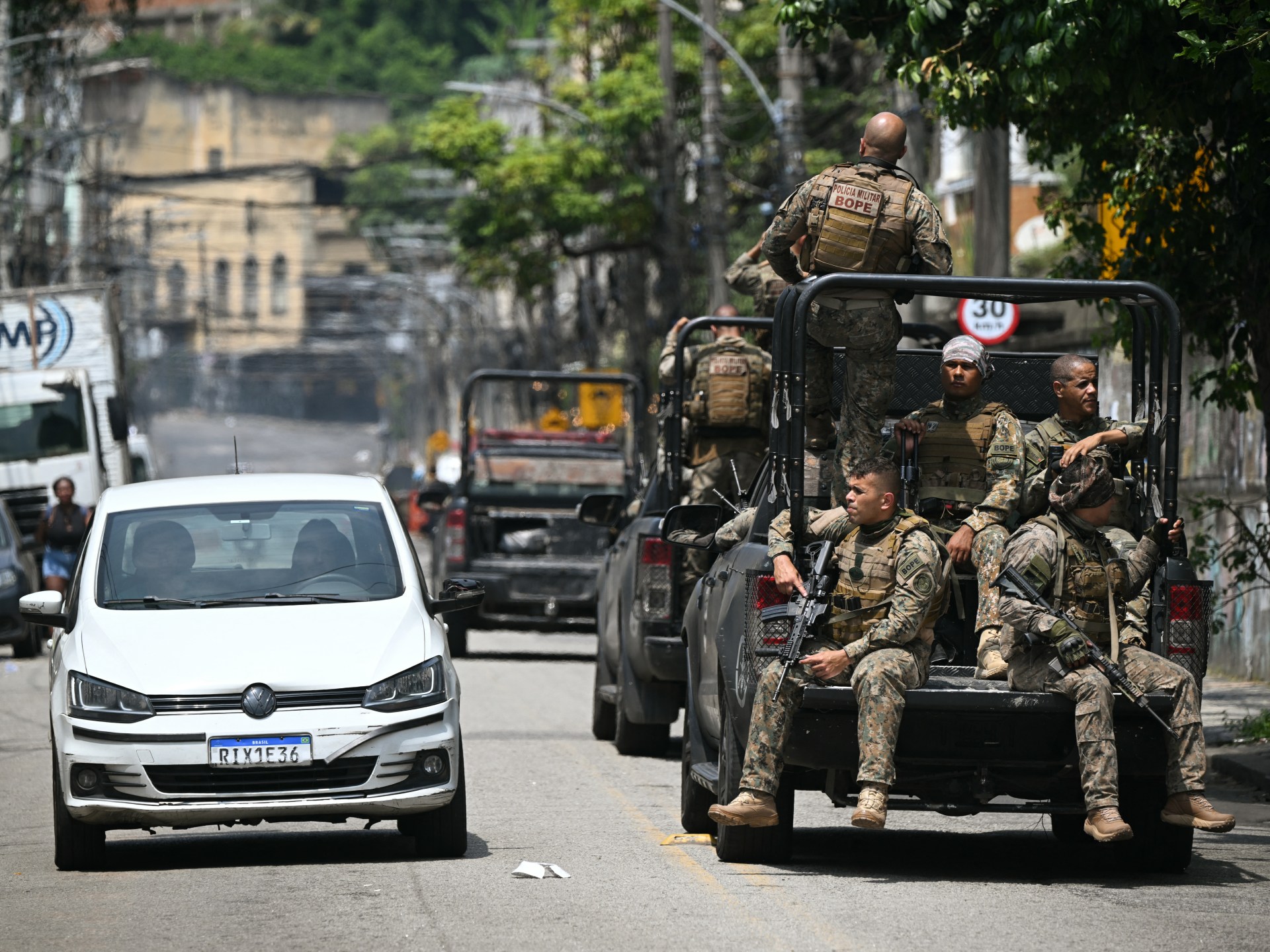

At least eight people have been killed during a police raid on a neighbourhood in the centre of Rio de Janeiro, continuing a trend of deadly operations in poor favela communities.
Brazilian police authorities said that Wednesday’s raid killed Claudio Augusto dos Santos, a commander of the powerful criminal group Comando Vermelho, or Red Command.
- list 1 of 3More than 130 killed: How did a Brazil raid on a Rio favela turn so deadly?
- list 2 of 3Demonstrators call for governor’s resignation after deadly Rio police raid
- list 3 of 3Brazil’s Supreme Court imposes steep sentences for Marielle Franco murder
end of list
Military police chief Marcelo Menezes Nogueira said that the raid resulted in a “major armed confrontation”. Dos Santos and six other suspected criminals were killed, and a local resident was reportedly caught in the crossfire after being taken hostage.
Local witnesses described individuals affiliated with the Red Command retaliating against the raid by blocking roads and setting a bus on fire.
“They boarded, told me to get the passengers off, and set the bus on fire. It all happened very fast,” bus driver Marcio Souza told the news service AFP.
Police said that five people were arrested for alleged acts of vandalism. About 150 military police officers took part in the raid in areas such as Prazeres, Fallet, Fogueteiro, Coroa, Escondidinho and Paula Ramos.
Dos Santos was linked to drug trafficking in the Prazeres favela, and there were 10 warrants for his arrest, according to media reports. Police have accused Dos Santos of involvement in the killing of an Italian tourist, Roberto Bardella.
Wednesday’s operation comes several months after an October police raid killed more than 130 people in the Rio favela of Complexo da Penha, raising questions about the methods of state security forces.
Advertisement
President Luiz Inacio Lula da Silva slammed that raid as a massacre.
Some politicians in Brazil’s left wing slammed Wednesday’s raid as a continuation of the trend towards reckless confrontations between police and organised crime.
“Another day of panic and fear in Rio de Janeiro,” Renata da Silva Souza, a state deputy for Rio de Janeiro, wrote online.
“It is a testament to the police’s lack of preparedness — having carried out an operation in Morro dos Prazeres without planning for the inevitable reaction. The outcome was entirely predictable: the local population caught in the crossfire, streets blocked off and a bus set ablaze.”
Souza added that she had filed a formal complaint to the public prosecutor’s office to seek accountability for the disruption to civilian life and the high death toll.
Politicians on Brazil’s right, meanwhile, have called for greater force to be used against criminals in the country.
“What is truly outrageous is what these criminals inflict upon those who have absolutely nothing to do with their activities,” Rio de Janeiro Governor Claudio Castro posted on social media.
“It is precisely because of such barbaric acts that the State cannot afford to take a single step back. We stand firmly on the side of the police and of law-abiding citizens.”
Media reports have indicated that the Brazilian government is currently trying to dissuade United States President Donald Trump from labelling groups such as Red Command as “foreign terrorist organisations”, a designation formerly used to identify groups that threaten US national security.
But increasingly, the Trump administration has applied the label to criminal networks and drug cartels across Latin America, placing them in the same category as organisations like al- Qaeda.
Critics warn that the use of the “foreign terrorist organisation” label has been used to promote militarised action against criminal groups across Latin America.
Related News
Five stories you may have missed amid US-Israeli war on Iran
Protesters in Cuba attack Communist party office in rare riot over blackout
Bangladesh shuts universities, limits fuel sale as Iran war causes shortage