
Iran’s paralysis of the Strait of Hormuz has led to major disruption in global oil and gas supply and many countries have begun tapping into their strategic oil reserves to evade an economic crisis.
Since the US-Israeli war on Iran began on February 28, Tehran, whose territorial waters extend into the Strait, has blocked the passage of vessels carrying 20 percent of the world’s oil and liquified natural gas (LNG) from the Gulf to the rest of the world. The strait is the only waterway to open ocean available for Gulf oil and gas producers.
- list 1 of 3Trump’s changing messages on Iran war: What does it say about US strategy?
- list 2 of 3Iranian authorities taunt US, Israel, EU amid strikes and assassinations
- list 3 of 3Did Israel miscalculate Iranian military capabilities?
end of list
Last week, the price of Brent crude topped $100 a barrel compared to the pre-war price of around $65.
The United States Trump administration has tried and failed to re-open the strait. First, it called on Western nations to send warships to help escort shipping through the strait – an option all have declined or failed to respond to. Then, on Sunday, Trump gave Iran 48 hours to reopen the strait or face US attacks on its power plants.
However, on Sunday, Iran said it would hit back at power plants in Israel and those in the region supplying electricity to US military assets. And, on Monday, Iran said it would completely shut the Strait of Hormuz if US attacks on its energy infrastructure continue.
Following Iranian attacks on energy infrastructure across the Gulf over the past three weeks, countries including Saudi Arabia, UAE, Iraq and Kuwait have also cut their oil output, raising further concerns about global oil and gas supply.
On Monday, Trump appeared to backtrack on his Hormuz ultimatum when he ordered all US strikes on power plants in Iran to be paused for five days and claimed the US was holding talks with Iran. Iran has denied this.
Advertisement
In the face of chaos, on March 11, the 32 member countries of the International Energy Agency (IEA) agreed to release 400 million barrels of oil from their strategic emergency reserves – the largest stock draw in the agency’s history. It is far higher than the 2022 release of 182 million barrels of oil by the group’s members after Russia invaded Ukraine.
What are strategic oil reserves and which countries hold them?
What is a strategic oil reserve?
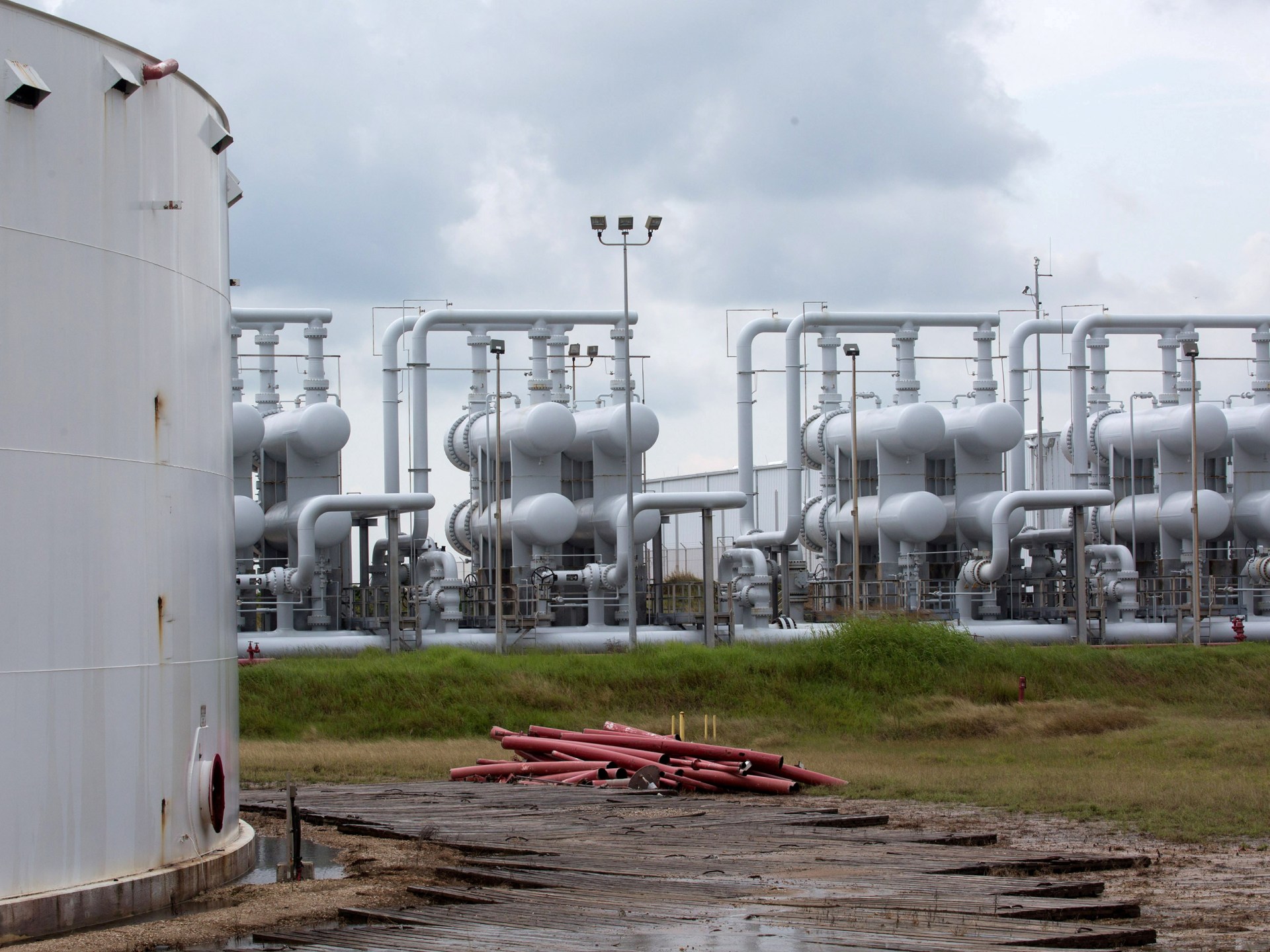
A strategic oil reserve or strategic petroleum reserve (SPR) is an emergency stockpile of crude oil which is held by the government of a country in government facilities.
This oil reserve can be drawn on in cases of emergencies like wars and economic crises. Governments generally buy the oil through agreements with private companies in order to keep their reserves filled.
According to the IEA, its members currently hold more than 1.2 billion barrels of these public emergency oil stocks with a further 600 million barrels of industry stocks held by private organisations but under government mandate to be available to supplement public needs.
Other reserves are also held by non IEA members like China.
Which countries have strategic oil reserves? Can they withstand the war in Iran?
China
Beijing is not an IEA member, but holds the world’s largest strategic oil reserve.
According to China’s Ministry of Ecology and Environment, Beijing “started a state strategic oil reserve base programme in 2004 as a way to offset oil supply risks and reduce the impact of fluctuating energy prices worldwide on China’s domestic market for refined oil”.
“The bases are designed to maintain strategic oil reserves of an equivalent to 30 days of imports, or about 10 million tonnes,” according to a 2007 report from Chinese state news agency Xinhua.
These strategic oil reserves are primarily located along China’s eastern and southern coastal regions such as Shandong, Zhejiang and Hainan.
China does not officially publish information about its crude inventories so it is not clear how much oil the country has in reserve. However, according to energy analytics firm Vortexa, in 2025, “China’s onshore crude inventories (excluding underground storage) continued to rise… reaching a record 1.13 billion barrels by year-end”.
According to data from Kpler, China bought more than 80 percent of Iran’s shipped oil in 2025. As the war in Iran escalates, therefore, Chinese companies such as refiner Sinopec have begun pushing for permission to use oil from the country’s reserves according to a Reuters report on Monday.
Advertisement
“We basically won’t buy Iranian oil, this is pretty clear,” Sinopec President Zhao Dong told a company results briefing in March, according to Reuters.
“We believe the government is closely monitoring crude oil and refined fuel inventories and market situations, and will advance policies at the appropriate time to support refinery productions,” he added.
US
Of the IEA members, the US holds one of the largest strategic oil reserves with 415 million barrels of oil. The stores are maintained by the US Department of Energy. It has confirmed that it will release 172 million barrels of oil from its SPR over this year as its contribution to coordinated efforts with the IEA.
On Friday, the Trump’s administration announced that it has already lent 45.2 million barrels of crude from the SPR to oil companies.
The US created its SPR in 1975 after an Arab oil embargo triggered a spike in gasoline prices which badly affected the US economy.
The reserves are located near big US refining or petrochemical centres, and as much as 4.4 million barrels of oil can be shipped globally per day.
The SPR currently covers roughly 200 days of net crude imports, according to a Reuters news agency calculation.
US presidents have tapped into the stockpile to calm oil markets during war or when hurricanes have hit oil infrastructure along the US Gulf of Mexico.
In March 2024, US President Joe Biden announced oil would be released from the reserve to ease pressure from oil price spikes following Russia’s invasion of Ukraine in February 2022 and amid subsequent sanctions imposed on Russian oil by the US and its allies.
Japan
An IEA member, Japan also has one of the world’s largest strategic oil reserves.
According to Japanese media Nikkei Asia, at the end of 2025, the country held about 470 million barrels of in emergency reserves which is enough to meet 254 days of domestic consumption. Out of this amount, 146 days worth of oil are government-owned, 101 days are owned by the private sector, and the remainder is jointly stored by oil-producing countries.
Japan set up its national oil reserve system in 1978 to prevent future economic disruptions following the global oil crisis in 1973. That oil crisis heightened Japan’s vulnerability and dependence on oil from abroad. The country remains one of the world’s largest oil importers, relying on fossil fuels from overseas for about 80 percent of its energy needs.
Japan’s reserves are primarily located in 10 coastal national stockholding bases with major storage sites in the Shibushi base in Kagoshima in southern Japan.
On March 16, Japan announced that it had begun releasing oil from its emergency reserves amid the global energy crisis sparked by the effective closure of the Strait of Hormuz.
Japanese Prime Minister Sanae Takaichi told journalists the country would unilaterally release 80 million barrels of oil from stockpiles amid supply concerns.
UK
As of February 26, according to the UK Department of Energy Security and Net Zero, the UK holds about 38 million barrels of crude oil and 30 million barrels of refined products, as strategic reserves. The reserves are thought to be able to last around 90 days.
Advertisement
The country established its reserves in 1974 following the oil crisis of the 1970s and also to meet its IEA obligations. Members of the organisation are required to maintain at least 90 days of net imports in reserve.
The UK’s strategic reserves are largely held by private oil companies, but are regulated by the government. Milford Haven in South Wales and Humber in northeast England are key locations of reserves.
The country is among the 32 IEA nations releasing oil from its reserve to address the oil crisis amid the war in Iran. The UK government will be contributing 13.5 million barrels as a part of the release.
EU
EU member nations including Germany, France, Spain and Italy, all IEA members, also hold strategic oil reserves.
Germany has 110 million barrels of crude oil and 67 million barrels of finished petroleum products which are held by the government and can be released in a matter of days, according to Germany’s economy ministry.
France reported about 120 million barrels’ worth of crude and finished products in reserve at the end of 2024, the most recent data publicly available. About 97 million barrels of that is held by SAGESS, a government-mandated entity, with a breakdown of about 30 percent crude oil, 50 percent gasoil, 9 percent gasoline, 7.8 percent jet fuel and some heating oil. Another 39 million barrels are held by the country’s oil operators.
On March 16, Spain approved the release of around 11.5 million barrels of oil reserves over 90 days to counter supply shortages caused by the effective closure of the Strait of Hormuz, Energy Minister Sara Aagesen told reporters. This is the country’s contribution to the IEA release. The country has around 150 million barrels of crude oil reserves in total.
Italy, by law, was holding about 76 million barrels of reserves, representing 90 days of Italy’s average net oil imports, in 2024.
Related News

Ukraine eyes money and tech in return for Middle East drone support
Iran announces arrests, says US and Israel suffering ‘defeats’
Iran strikes towns near Israel’s nuclear site in escalating tit-for-tat