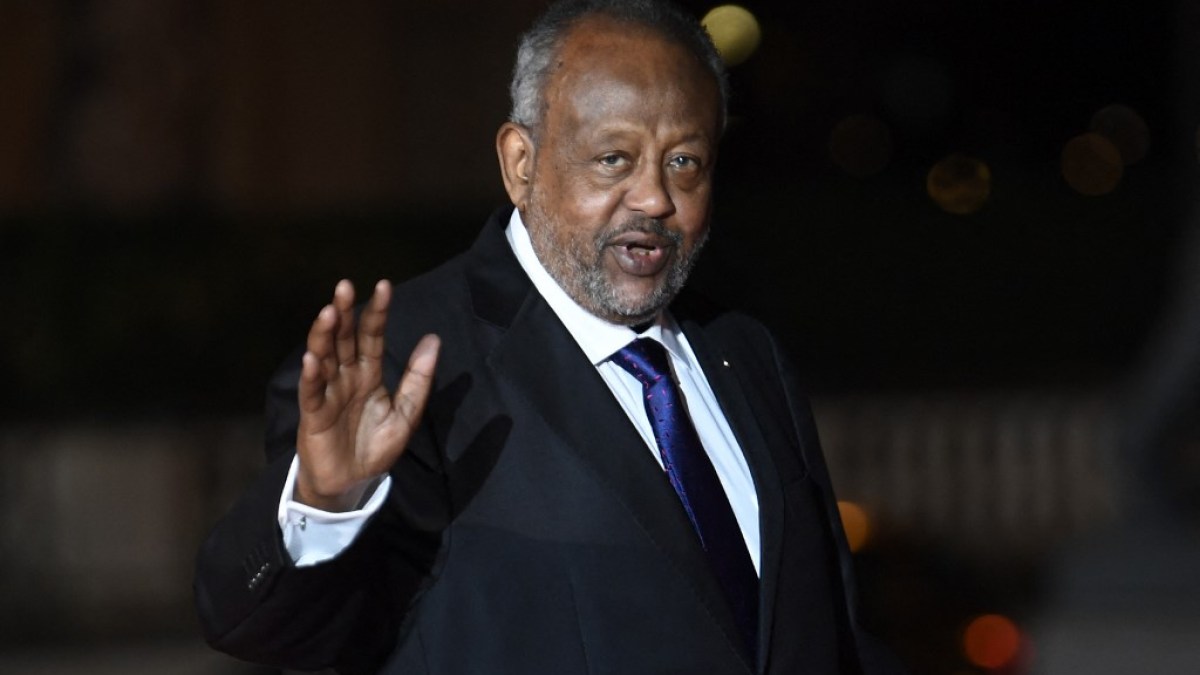

As the small East African coastal nation of Djibouti prepares for presidential elections on Friday, longtime leader President Ismail Omar Guelleh is expected to win the polls with little to no challenge.
Djibouti, a country of just about one million people that neighbours Eritrea, Ethiopia and Somalia, is politically relevant in the Horn of Africa region. It is also internationally important due to its strategic location right at the Bab al-Mandeb Strait, which provides access to the Red Sea from the Gulf of Aden and through which a large portion of global trade between Asia and the West passes.
- list 1 of 3‘Our geography is our oil’: Why Djibouti hosts many foreign military bases
- list 2 of 3Djibouti and the Horn of Africa: new front in the war on Iran
- list 3 of 3Djibouti lifts presidential age limit, paving way for sixth Guelleh term
end of list
Djibouti hosts important military bases for the United States, France, China and other powers, earning it the tag of the country with the most foreign military bases. It is also an important port hub for bigger inland landlocked countries like Ethiopia.
Incumbent candidate Guelleh is running for his sixth term as president. Though originally ineligible due to term limits and age, lawmakers removed age limits last year, paving the way for another term in office.
Formerly named French Somaliland under colonialism, the country continued to maintain large numbers of French troops following independence in 1977, but it was the September 11, 2001, attacks in the US that saw it garner new attention as Washington sought proximity to armed groups in Somalia and Yemen.
Djibouti was also a strategic military launchpad for naval units during the anti-piracy fights of the mid-2000s when the US, European Union, and other allies sought to battle pirates off the coast of Somalia.
Both French and Arabic are official languages in Djibouti. Somali and Afar are also widely spoken by Somalis, who make up about 60 percent of the population, and people from the Afar group, who comprise about 35 percent.
Advertisement
About 94 percent of people in Djibouti practise Islam. The local currency is the Djiboutian franc.
Here’s what to know about Friday’s election:
Who is eligible to vote?
About a quarter of the population, or 243,471 people, are registered to vote in the polls, according to the International Foundation for Electoral Systems. That’s up from the last presidential election in 2021, when about 215,000 were registered.
Voter turnout on average is about 67 percent.
Polls are expected to open early on April 10 and close in the evening.
Although Djibouti is described by monitors as an “electoral autocracy”, election observers from the Intergovernmental Authority on Development (IGAD), an eight-country regional bloc, arrived there on Tuesday.
IGAD said 17 observers from Ethiopia, Kenya, Somalia, South Sudan and Uganda will be deployed across all regions, and will release a statement after the vote on April 12.

Who is running?
Ismail Omar Guelleh: The 78-year-old incumbent, known as “IOG”, is running for his sixth term as president. He was first voted into power in 1999. His party is the ruling People’s Rally for Progress.
Guelleh’s latest bid came after lawmakers in November unanimously amended the constitution to remove a 75-year-old age limit. Back in 2010, parliament had scrapped term limits in a constitutional reform.
Guelleh has been criticised for ruling with an iron fist and holding on to power unconstitutionally. However, he is also credited with maintaining a relatively stable hold in a region that’s usually rife with instability.
Under his rule, Djibouti, which has no natural resources, has signed infrastructure deals with China and lucrative military hosting pacts with Western powers by leveraging its location.
Djibouti Finance Minister Ilyas Dawaleh in 2017 said the country makes $125m a year from hosting US, French, Chinese, Italian and Japanese military bases, with Washington paying almost half of that.
The US base, Camp Lemonnier, is the only permanent US military base in Africa.
Guelleh, donning his party’s leaf-green colours, spoke to hundreds of his supporters during campaign rallies that were held in the capital this month.
In one campaign, he said the elections and the choices available to voters “are consistent with democracy” in the country and promised more “significant success” if elected. His supporters held up banners that read “national unity and social cohesion”.
Advertisement
Mohamed Farah Samatar: Guelleh’s only rival is a former member of the ruling party. He is running under the Unified Democratic Centre party.
Samatar rallied in Tadjourah and Obock regions with his supporters, claiming that “another Djibouti is possible”.
Sonia le Gouriellec, a Horn of Africa expert at Lille Catholic University, told the AFP news agency: “There’s not much at stake [in the election]. It’s just a token competition.”
Omar Ali Ewado, head of the Djibouti League of Human Rights (LDDH), called the vote a “masquerade” and said it is a “foregone conclusion”.
“The person who will challenge President Guelleh is a member of a small party subservient to those in power,” he told AFP.

What are the key issues?
Shrinking democratic freedoms
Guelleh’s critics are increasingly sounding the alarm about the shrinking of civic space in the country.
Elections have been described as merely ritualistic, with Guelleh winning more than 90 percent of votes in the 2021 polls. Since 2016, opposition parties have boycotted elections.
Guelleh’s government is also accused of high levels of corruption and nepotism, with some speculating that his stepson and the secretary-general of the prime minister’s office, Naguib Abdallah Kamil, is being prepared for the top job.
The country is regularly singled out by human rights organisations for its repression of dissenting voices. It is currently ranked 168th out of 180 in the 2025 press freedom index published by Reporters Without Borders (RSF).
One aspiring presidential candidate, Alexis Mohamed, who formerly served as presidential adviser until he resigned in September, told reporters he was “unable” to pursue his candidacy because he had no “security guarantees” if he were to return to the country from his current location abroad.
Mohamed, who served in an official capacity for 10 years, accused Guelleh of “patronage-based management of the state”.
According to the International Federation for Human Rights, elections in Djibouti are “not free”.
Rising debt
Many accuse Guelleh of brandishing shiny infrastructure projects built by China, such as a railway to Ethiopia, but point to the country’s stagnating economy and rising debts to Beijing.
By 2026, the country owed China $1.2bn from loans, as well as several others. The International Monetary Fund said in a report in 2025 that Djibouti’s debt profile is “in distress and unsustainable”.
Some of these costly infrastructure projects have not had an impact on lowering poverty rates. About 73 percent of the country’s young population is unemployed due to a dearth of jobs, for one example.
Meanwhile, a major source of the country’s revenue is under threat: Djibouti’s ports almost entirely handle Addis Ababa’s maritime imports and exports for about $2bn annually.
However, in 2024, Ethiopia is seeking to reduce that independence. The country signed a port deal with autonomous Somaliland, a case that has caused tensions with Djibouti as well as Somalia, which considers Somaliland part of its own territory.
Advertisement
Following Turkiye-led mediation, Ethiopia and Somalia reached a preliminary understanding in late 2024 to resolve their dispute. Ethiopia has agreed to pivot to “reliable and sustainable” sea access with Somalia rather than with Somaliland.
Related News
History’s biggest census: Why India’s new population count is controversial
Qatari PM and US officials discuss strategic ties amid Iran war
As war rages, Iranian politicians push for exit from nuclear weapons treaty