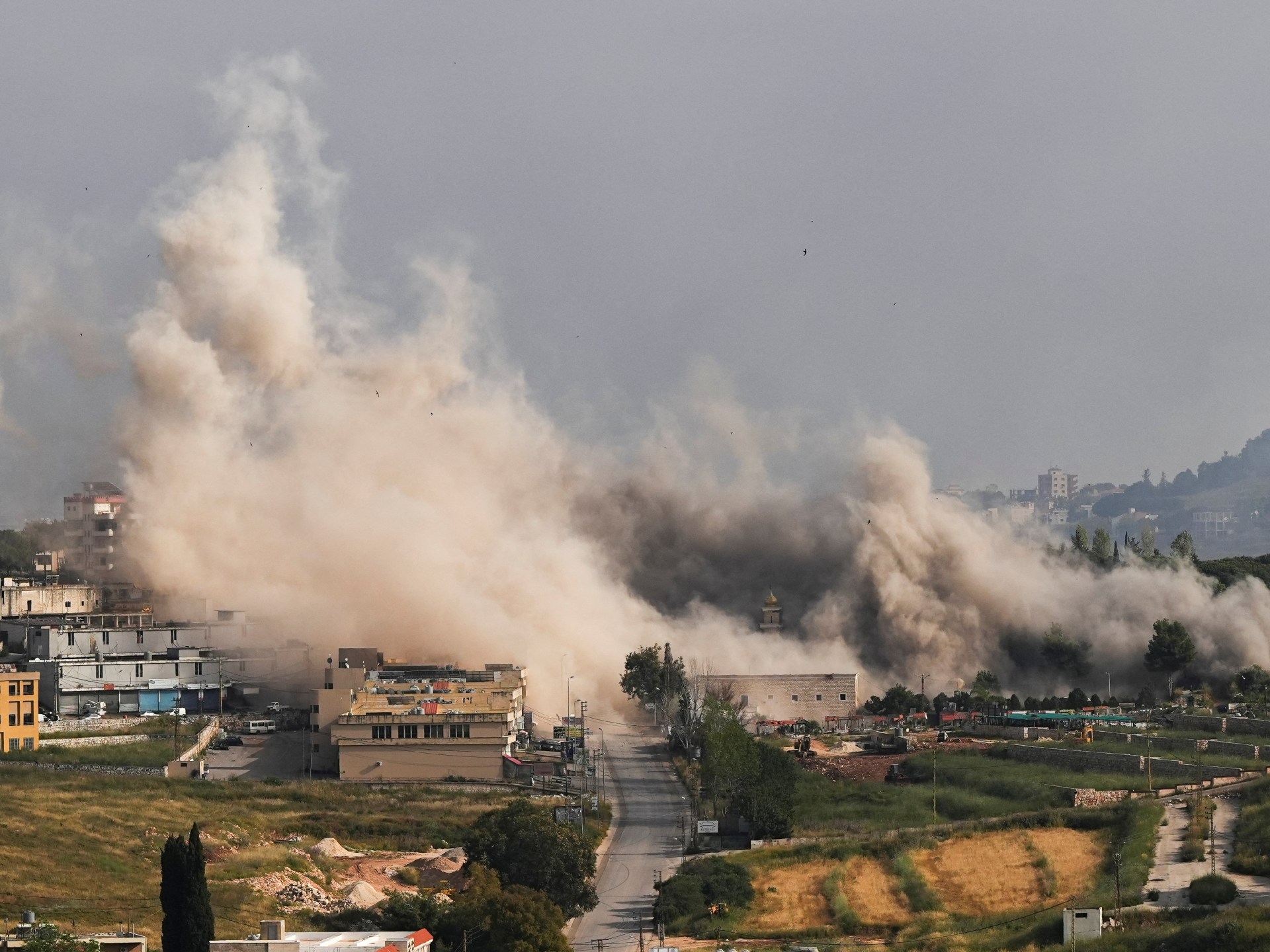

Beirut, Lebanon – The Israeli military ordered the forced displacement of the population of Lebanon’s southern city of Nabatieh on Tuesday, amid an escalation of its campaign – ostensibly against Hezbollah targets – in Lebanon.
Israel hit towns on the outskirts of Nabatieh on Wednesday with “near continuous artillery shelling”, Al Jazeera’s Zeina Khodor reported, coming as Muslims in the country celebrated the religious holiday of Eid al-Adha.
Local media reported that Israel hit Nabatieh multiple times on Tuesday, including direct air strikes on a cemetery in the city limits. Israel also struck surrounding villages, with the village Yohmor al-Shaqif hit multiple times.
For its part, Hezbollah announced artillery and drone strikes on the advancing Israeli forces around the town of Zawtar al-Sharqiya, in the Nabatieh district.
Israel has killed at least 3,213 people in Lebanon, including paramedics and civilians, since it intensified its war on Lebanon on March 2, expanding its invasion and occupation of southern towns and villages.
Despite US President Donald Trump announcing another ceasefire on April 16, Israel and Hezbollah have continued to trade attacks, while Israel has established an approximately 10km (six-mile) buffer zone whose northern periphery is marked by what Israel calls a “yellow line.”
So why is Israel focusing so heavily on Nabatieh, the second-biggest city in southern Lebanon?
Here is all you need to know.
Where is Nabatieh?
Nabatieh is a city and a municipality in southern Lebanon that sits above the Litani River, and about 11km (seven miles) from the southern border.
Advertisement
The Litani has been a focal point of past ceasefire and international agreements, often stating that Hezbollah’s presence should retreat to the north of the Litani.
Surrounding Nabatieh city are a number of villages that have also been regularly attacked or destroyed by Israeli attacks.
Why is Israel focused on Nabatieh?
The recent focus on Nabatieh is an effort to “transform it into one of the villages or cities included below the yellow line”, Jad Dilati, a political analyst from Nabatieh, told Al Jazeera.
Nabatieh is a historic symbol of resistance in Lebanon. Many locals point to the Ashura Uprising in 1983, when Israeli soldiers drove towards a crowd performing a religious ceremony in the city. The brigade tried to force its way through the procession but was met by tens of thousands of angry civilians.
The incident came in the early years of the Israeli occupation of southern Lebanon (1982-2000), which ended with Israeli expulsion and withdrawal.
“It is said that this [incident] was the spark that triggered radicalisation and a belief in armed resistance for the next 18 years,” Dilati said.
Is that the only reason?
Nabatieh’s inhabitants are predominantly Shia Muslim, and the city is a crucial hub for south Lebanon’s economy. Israel’s war on Lebanon has not just been about killing Hezbollah fighters but also putting pressure on the Shia community, from which Hezbollah derives the majority of its support.
“I would see this targeting of Nabatieh as part of that overall strategy to essentially cripple the Shia community in Lebanon and one way to do that is by destroying different economic engines and the capacity of that community and one of the largest economic engines of the south is Nabatieh,” Mohamad Bazzi, a DAWN fellow, told Al Jazeera.
Dilati said Israel is targeting Nabatieh due to its status as an “administrative, economic, and symbolic heart of the south”. He said the idea is to hurt the Shia community as a means of forcing Hezbollah to end the war.
“They [hope they] can pressure Hezbollah to end the war by making the return [of people] impossible and by making everyday life impossible.”
What is Israel saying?
Israel’s Prime Minister Benjamin Netanyahu announced his military’s intention to “crush” Hezbollah. On Tuesday, Netanyahu said that the Israeli military had expanded its operations beyond the so-called “Yellow Line”.
“We are at war with Hezbollah, and we will intensify our strikes,” he said in a video released Monday on the messaging app Telegram.
Advertisement
His announcement led to an exodus of people from Beirut’s southern suburbs. Many had returned home since the ostensible ceasefire began due to a halting of attacks on Beirut.
While Israel says it is attacking Hezbollah targets, many civilians have also been killed. On Wednesday, Lebanon’s Civil Defence forces announced they had rescued 15 civilians in Nabatieh trapped inside damaged buildings.
Israel has also repeatedly targeted paramedics, sometimes in double or triple-tap strikes, and has killed at least 15 journalists, according to the Committee for the Protection of Journalists (CPJ).
How is Lebanon responding?
The government is preparing for direct negotiations with Israel on June 2 and 3.
Addressing the nation on Eid al-Adha holiday, Lebanon’s President Joseph Aoun said that Lebanon needs “love, solidarity, and unity … in light of the difficult circumstances and challenges facing Lebanon, especially as a result of the continued Israeli attacks”.
How has Hezbollah responded?
The group said its fighters clashed with Israeli forces in Zawtar al-Sharqiya, in the Nabatieh district, at “point-blank range.”
On Sunday, Hezbollah leader Naim Qassem delivered a televised address denouncing upcoming direct negotiations between Lebanon’s government and Israel.
Is this the first attack on Nabatieh?
“Nabatieh has been repeatedly targeted since the 1978 invasion, 1982 occupation, in 1993 and in 1996, and in 2006, in 2024, and now,” Dilati said.
Nabatieh was attacked daily during Israel’s 2024 intensification, destroying the town’s historic souk. Even during the ceasefire period, Israel attacked both Nabatieh as a city, as well as the wider district.
During the latest intensification, which started on March 2, Israel has attacked Nabatieh and its surrounding areas repeatedly.
“Even before today, almost every area or province of Nabatieh has received an evacuation order,” Dilati said. Surrounding areas were already emptied by previous evacuation orders and intensive bombardment that destroyed significant segments of the city, he added.
How are the people of Nabatieh being affected?
More than 1.2 million people in Lebanon are displaced, including many from Nabatieh and the surrounding towns and villages.
Speaking shortly after the announcement of the ceasefire on April 16, one man from a village near Nabatieh who has been displaced to Beirut’s waterside, told Al Jazeera he would not return home until Parliament Speaker Nabih Berri announced it was safe.
In 2024, many in and around Nabatieh fled their homes. Locals said that many had stayed home during this latest intensification, either after what they said was indignity in 2024, during another mass displacement, or because they could no longer afford alternative housing.
“What the evacuation order for the entire city did was force whoever remained, whoever didn’t want to leave, to leave because they saw the intensity of the air strikes in the past few days, and the evacuation order instilled a sense of genuine fear in its residents who are now all displaced,” Dilati said. “And the city is now effectively empty, and the next goal is to destroy the city.”
Related News
Iran war live: Tehran warns of ‘many more surprises’ if conflict resumes

UK launches ‘Great British Summer Savings’ to ease family costs
Poll finds nearly three-quarters of Democratic voters oppose aid to Israel