
Tehran, Iran – Iranian authorities have expressed readiness for stronger military confrontation if necessary, after ending an exchange of fire with Israel that raised concerns of a return to all-out war.
Iran’s armed forces on Sunday night launched an air attack against Israel in response to strikes on the Beirut suburb of Dahiyeh in Lebanon, as they had previously threatened to do if Israeli raids continued.
Israel’s government said it targeted a command centre of the Lebanese armed group Hezbollah, while US media reports said Washington was aware of and supportive of the attack that killed at least two people.
Iran fired ballistic missiles from multiple cities, including Kermanshah in the west, in a likely attempt to showcase retained military capabilities, despite nearly 40 days of intense bombardment during the war that the United States and Israel began on February 28 .
In launching operation “Nasr” – which means victory – Iranian authorities also showed that they were willing to immediately enforce a deterrent warning for the Dahiyeh suburb of Beirut, rather than reacting to the killing of Iranian generals or accumulated grievances, as with previous instances of attacks against Israel.
The emboldened move diverges from a long-standing policy of absorbing hits first and retaliating at a later time and place of their choosing.
“As we promised, we have acted,” Ebrahim Zolfaghari, the spokesman for the Khatam al-Anbiya Central Headquarters, the unified command of Iran’s armed forces, said in a video statement on Monday afternoon, after Iran and Israel exchanged several rounds of fire for several hours.
Advertisement
The Islamic Republic and its “axis of resistance” of aligned forces across the region will “never bow in submission to enemies that have been defeated in war”, he said. The command later said its attacks were over, but warned of harsher ones if the Israeli targeting of Lebanon persists.
According to state TV, the Iranian missiles targeted sites in Tiberias and Nahariya that provide military support for troops in southern Lebanon, as well as the Ramat David, Tel Nof and Nevatim military airbases.
For their part, Israeli warplanes attacked the capital, Tehran, and other cities. One of the first targets was Karun, a major petrochemical plant in Mahshahr that produces methylene diphenyl diisocyanate (MDI) and toluene diisocyanate (TDI), industrial chemicals used mainly in materials for car seats, mattresses and sofas, among other things.
The city of Mahshahr also houses several other petrochemical giants, forming the backbone of Iran’s non-oil economy, which were extensively bombed during the war in order to further damage the ailing economy.
The Israeli army, which during the war also hit major steel and aluminium factories as well as other civilian infrastructure in Iran, on Monday framed the latest strikes as hitting “infrastructure for producing raw materials for the Iranian terror regime’s missile programme”.
It also reported attacks against “strategic defence systems”.
In response, the Islamic Revolutionary Guard Corps (IRGC) attacked the Bazan oil refinery in Haifa, but the potential damage was unclear. The IRGC-linked Fars news agency cited an unnamed source as saying that other countries in the region could see their energy infrastructure attacked if Iran’s facilities are targeted again.
State TV also aired live pictures from a fast boat in the Strait of Hormuz in southern Iranian waters, and speaking by radio with an IRGC naval commander who said any “hostile military vessels” are banned from entering and will be “targeted without hesitation”.
In a social media post on Monday, US President Donald Trump argued that Israel and Iran “are looking to do an immediate ceasefire”, adding that he would keep the blockade of Iran’s ports in place.
In Tehran, the streets were buzzing with usual traffic on Monday morning and throughout the day, despite the renewed bombing, as well as a loud boom heard around noon in many neighbourhoods of the city of about 10 million. Local media said a hostile drone was shot down over western Tehran.
Petrol stations were busy, as they have mostly been over recent weeks. There was no additional rush to move around or get out of the capital, as some did at the start of the war.
Advertisement
The authorities of the Islamic Republic touted the perceived value of the latest strikes against Israel as going beyond a simple military response, and there was no publicly visible internal strife over the decision to carry out the attacks.
Sadegh Amoli Larijani, the head of the influential Expediency Council, described the move as “the official announcement of a strategic doctrine”.
“Tehran has opened a new chapter in its defence policy; a chapter in which safeguarding regional power is followed not through awaiting threats, but through taking initiative and offensive power,” he wrote in a statement on Monday.
Army chief Amir Hatami said in reference to Israel that “responsibility for the aggression of the Zionist regime lies with the US”, and vowed to fight to the last drop of blood.
Speaking to reporters during a briefing in Tehran, Foreign Ministry spokesman Esmail Baghaei said that despite what US officials say, Iran is aware that US Central Command is “fully coordinated and cooperating with the Zionist regime in both defensive and offensive operations”.
He classified Iran’s attacks as a “defensive measure” that corresponded with the right of self-defence enshrined in the United Nations Charter.
Ebrahim Rezaei, the spokesman of the national security commission of the hardline-dominated parliament, wrote on X that “the path of peace and stability goes through war” and that conflict will come if a country is unprepared to defend itself.
IRGC aerospace chief Majid Mousavi released his first video message since the start of the war, and asked supporters of the Islamic Republic to keep taking to the streets every night to combine “the field of battle, the street and diplomacy” together to thwart enemies.
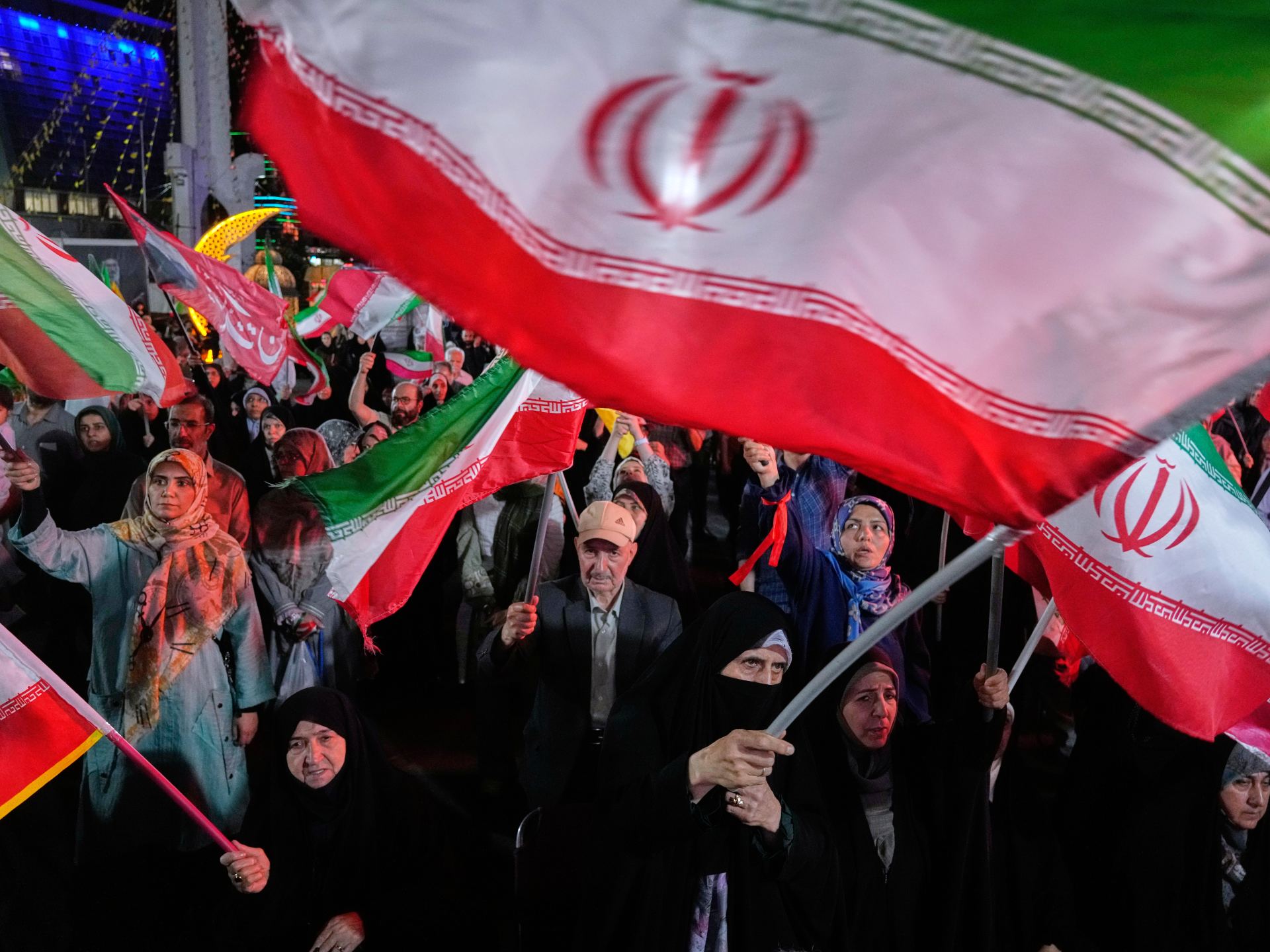
Some of those supporters were shown by state media to be cheering on the streets on Sunday night after hearing about the missile launches against Israel.
Still, many were worried that the authorities would once again resort to shutting down the internet based on vague security considerations, although no sudden outage was reported amid the flare-up of conflict. The internet has only been partially restored since late May after three months of near-total shutdown, but heavy filtering makes access difficult for most.
A young man who works as a data analyst at a tech company in Tehran told Al Jazeera that many colleagues and friends went to work at the office, or otherwise carried on with their day on Monday, while staying updated on the news.
“Sadly, in this situation you adapt to a lot of abnormal things much more quickly than you might have imagined,” he said.
Related News

Jill Biden worried husband Joe was ‘having a stroke’ during 2024 US debate
Iran war day 88: US attacks near Strait of Hormuz; talks under way in Qatar
Pope says AI must be ‘disarmed’ to prevent domination, exclusion, and death