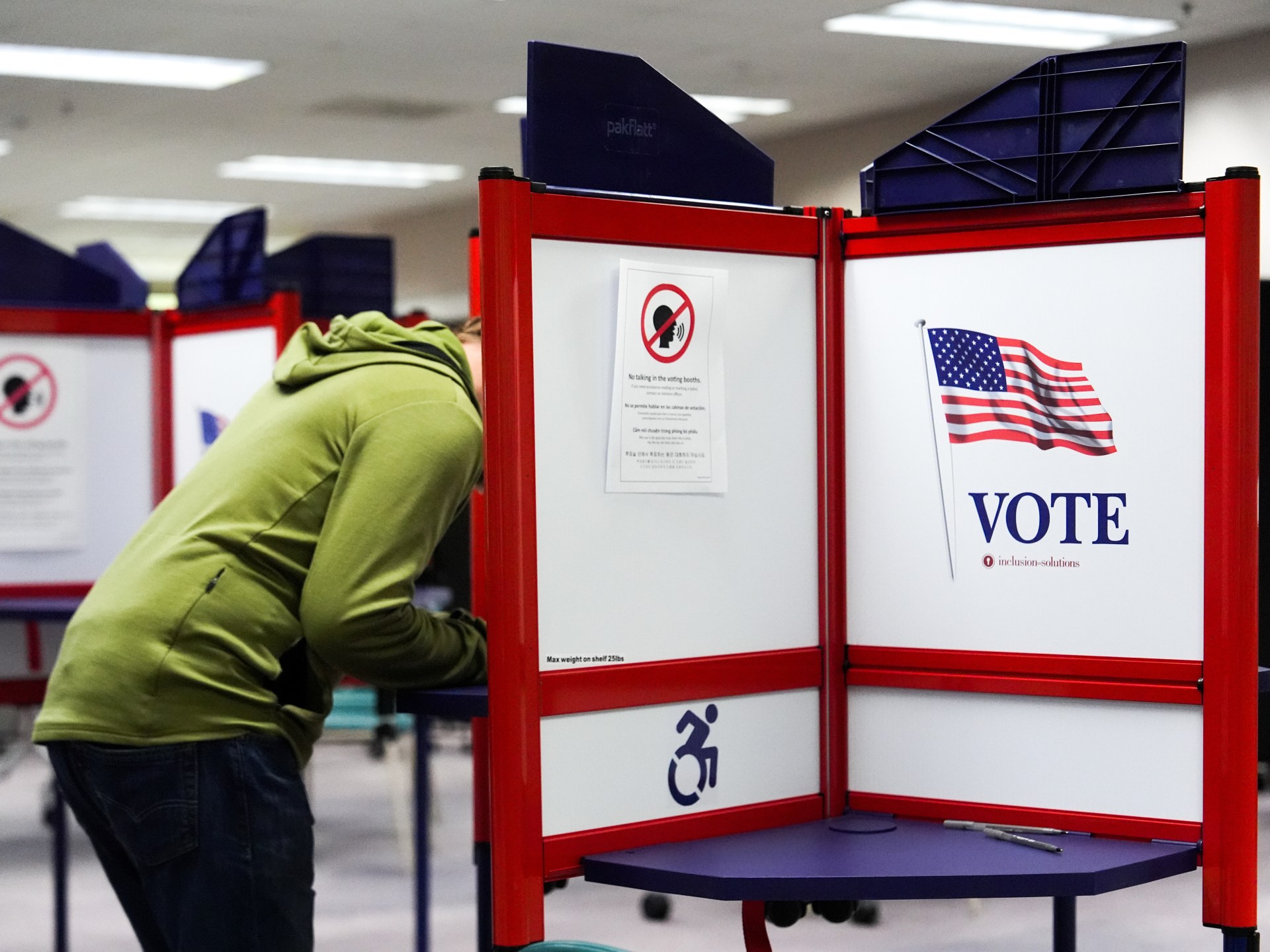

Voters in five US states – Kansas, Missouri, Virginia, Michigan, and Washington – are headed to the polls for another key round of midterm primaries, where they will choose the Republican and Democratic candidates to compete in November’s elections.
Several of the contests on Tuesday will help shape the battle for control of the US Congress, where Democrats need to flip four Senate seats and three House of Representatives seats to regain the majority. Others will test President Donald Trump’s influence over the Republican Party, and highlight growing divisions within the Democratic Party over issues including Israel’s genocidal war on Gaza and a progressive flank that has been gaining ground.
- list 1 of 4Chris Rabb win in Pennsylvania energises Democrats’ progressive flank
- list 2 of 4Anti-war candidates pose early test for US Democrats after attacks on Iran
- list 3 of 4US Arabs eye ‘historic’ Senate win for Abdul El-Sayed despite AIPAC attacks
- list 4 of 4How much has AIPAC spent against Michigan’s Abdul El-Sayed? And why?
end of list
You can read about the Michigan primary here. But there are also crucial races happening across four other states, from competitive House battlegrounds to high-profile intraparty fights that could offer an early glimpse of the political landscape heading into November.
Here are the ones we are watching.

In Kansas, a crowded battle to replace Laura Kelly
- When does voting in Kansas start? Polls can open as early as 6am (11:00 GMT), although opening times vary by county.
- When does voting in Kansas end? Polls close no earlier than 7pm on Tuesday (00:00 GMT on Wednesday). Most polling places close at 7pm local time, though some counties may remain open until 8pm (01:00 GMT on Wednesday).
What’s one big race to watch? The Republican primary for governor.
Advertisement
The biggest contest in Kansas is not for Congress but for governor, where both parties are choosing nominees to replace Democrat Laura Kelly, who has already served two terms and cannot run again.
The open race gives Republicans a major opportunity to reclaim the governor’s office in a state that Trump won comfortably in 2024. But Kansas has a long history of electing governors from the opposite party, making the race more competitive than its Republican tilt might suggest. Trump has already weighed in, endorsing Kansas Senate President Ty Masterson.
Masterson is one of seven Republicans running for the nomination, including Kansas Secretary of State Scott Schwab, Insurance Commissioner Vicki Schmidt, and several others.
Schwab has emerged as one of Masterson’s highest-profile rivals after gaining national attention for defending the integrity of Kansas’s elections against Trump’s claims that the 2020 election was stolen and breaking with Republicans on voting rights issues, even while maintaining a broadly conservative record.
On the Democratic side, state Senators Ethan Corson and Cindy Holscher are competing against Overland Park Mayor Curt Skoog.
Another closely watched race in Kansas will be in the 3rd Congressional District, one of the state’s few politically competitive seats, and a target for Republicans.
Representative Sharice Davids, the only Democrat in Kansas’s congressional delegation, is seeking another term after winning the district four consecutive times, despite a redistricting effort to make it more favourable to Republicans.
Davids faces a primary challenge from progressive Democrat Sarah Preu, who argues Davis has not gone far enough on issues like immigration. Preu is campaigning on abolishing the Immigration and Customs Enforcement (ICE) agency, ending US military aid to Israel and refusing donations from corporate political action committees, positioning herself as the more progressive alternative to Davids.

In Missouri, Wesley Bell and Cori Bush face off again
- When does voting in Missouri start? Voting starts at 6am on Tuesday (11:00 GMT).
- When does voting in Missouri end? Voting closes at 7pm Tuesday (00:00 GMT on Wednesday).
- What’s one big race to watch? The Democratic primary rematch between Representative Wesley Bell and former Representative Cori Bush, widely viewed as a proxy battle over Gaza, the influence of the American Israel Public Affairs Committee (AIPAC), and the future of the party’s progressive wing.
Advertisement
Missouri’s heavily Democratic 1st Congressional District will see Representative Wesley Bell face former Representative Cori Bush, who was part of a group of progressive House members known as The Squad, in a bitter rematch.
The primary will also be the first held under Missouri’s newly redrawn congressional map, approved by Republicans after Trump urged Republican-led states to redraw congressional boundaries in hopes of expanding the party’s House majority.
Bell narrowly unseated Bush in 2024, ending the progressive former Black Lives Matter organiser’s two terms in Congress. The two are now squaring off again in a race that has become an early test of whether Democratic voters are shifting back towards more progressive candidates, particularly as criticism of Israel’s war on Gaza has grown within the party.
Bush, an early advocate of a Gaza ceasefire and a fierce critic of US military support for Israel, has cast the race as a fight against the Democratic establishment and the influence of pro-Israel money. Bell has taken a more traditional Democratic approach, backing Israel while arguing the US should also press its ally to improve humanitarian conditions and protect civilians.
The race has once again attracted millions of dollars in outside spending from the political arm of the pro-Israel lobbying group AIPAC, which spent about $3.1m in July backing Bell and opposing Bush ahead of the primary, according to the Associated Press. Bell has also picked up endorsements from Democratic leaders, including former House Speaker Nancy Pelosi.
But Gaza is only part of the story. Both candidates emerged from the political movement that followed the 2014 police killing of Michael Brown in Ferguson, Missouri, and voters are also weighing their records on healthcare, disaster relief and local issues. Because the district is safely Democratic, whoever wins the primary will be favoured in November.

In Virginia, House battlegrounds take shape as Republicans pick Senate nominee
- When does voting in Virginia start? Voting starts at 6am on Tuesday (10:00 GMT).
- When does voting in Virginia end? Voting closes at 7pm on Tuesday (23:00 GMT).
- What’s one big race to watch? The rematch in Virginia’s 2nd Congressional District, where Republican Jen Kiggans and Democrat Elaine Luria are on course to face off in one of the country’s most competitive House races.
While Virginia is unlikely to decide control of the Senate, several of its congressional races could play an outsized role in the fight for the House.
In the coastal 2nd District, Republican Representative Jen Kiggans, a US Navy veteran and former state senator, is defending one of the country’s most competitive swing seats against former Democratic Representative Elaine Luria, also a Navy veteran who served on the House committee investigating the January 6 attack on the US Capitol.
Advertisement
Home to one of the US’s largest military communities, the district has become a top Democratic target, with the Democratic Congressional Campaign Committee adding Luria to its “Red to Blue” programme, which provides extra support to some of the party’s most competitive challengers.
Democrats will also be defending Representative Eugene Vindman in the 7th District, where he won by under three percentage points in 2024, making the seat another top Republican target. Three Republicans are competing for the nomination, including Doug Ollivant, the former director for Iraq at the National Security Council, entrepreneur Philip Harding, and US Army veteran and longtime construction worker Rick Smithers.
The state’s senate race is expected to be less competitive. Three Republicans are competing for the chance to challenge Democratic Senator Mark Warner in November, but whoever wins is likely to be the underdog in November.
Warner, a former Virginia governor and technology executive seeking a fourth term, is one of the state’s best-known politicians. As the top Democrat on the Senate Intelligence Committee, he has amassed a campaign war chest of more than $25m, won re-election by double digits in 2020, and faces no Democratic primary challenger.
His Republican rivals — former federal accountant Kim Farington, retired US Army Major General Bert Mizusawa, and former diplomat and US Marine veteran David Williams — have all campaigned on familiar conservative priorities, including shrinking the federal government, fiscal restraint and national security.

In Washington, a House toss-up and a Democratic foreign-policy fight
- When does voting in Washington end? Washington votes almost entirely by mail. Ballots must be postmarked by Tuesday or placed in an official drop box by 8pm local time (03:00 GMT on Wednesday) to be counted.
- What’s one big race to watch? Washington’s 3rd Congressional District, where Democrat Marie Gluesenkamp Perez is defending a key House battleground that could help determine control of the chamber in November.
Because the northwestern state of Washington uses a top-two primary system, the two candidates who receive the most votes in each race advance to November regardless of party affiliation, meaning it’s possible for two candidates from the same party to move on.
In Washington’s 3rd congressional district, carried by Trump in 2024, Democratic Representative Marie Gluesenkamp Perez is seeking a third term in a contest that analysts are calling a toss-up.
Her strongest Republican opponent is Trump-endorsed Washington State Senate Minority Leader John Braun, who’s looking to succeed where Republican Joe Kent failed twice, after the former auto shop co-owner narrowly won the seat in 2022 and held it again in 2024 by cultivating an independent-minded, working-class image and occasionally breaking with her party. She’s also facing a challenge from the left from progressive Brent Hennrich.
Out of nine candidates in the primary, Gluesenkamp Perez and Braun are the ones widely expected to advance, but the race is widely seen as a bellwether for the midterms.
Another contest worth watching is in Washington’s safely Democratic 9th District, where longtime Representative Adam Smith faces several challengers, including Democratic candidate Melissa Chaudhry and independent socialist Kshama Sawant.
Smith, who’s represented the district for nearly three decades and has frequently criticised the Democratic Party’s left flank, is a senior member of the House Armed Services Committee and a prominent supporter of US defence spending.
Advertisement
Sawant, who served for a decade on the Seattle City Council, is campaigning on an explicitly antiwar platform that includes ending US arms transfers to Israel. Chaudhry, who also challenged Smith in 2024, is running as a progressive alternative focused on healthcare, immigrant communities and reducing military spending.
While Smith is widely expected to advance, the primary offers another gauge of the Democratic Party’s internal fight over Gaza, defence spending and whether opposition to the party’s foreign-policy establishment can translate into votes.
Related News

Ukrainian drone attacks on Russia kill at least 8, wound dozens

Indonesia’s anti-graft prosecutor quits after police seize gold and cash

Why did Ceuta migrant mayhem chill already frosty Israel-Spain relations?