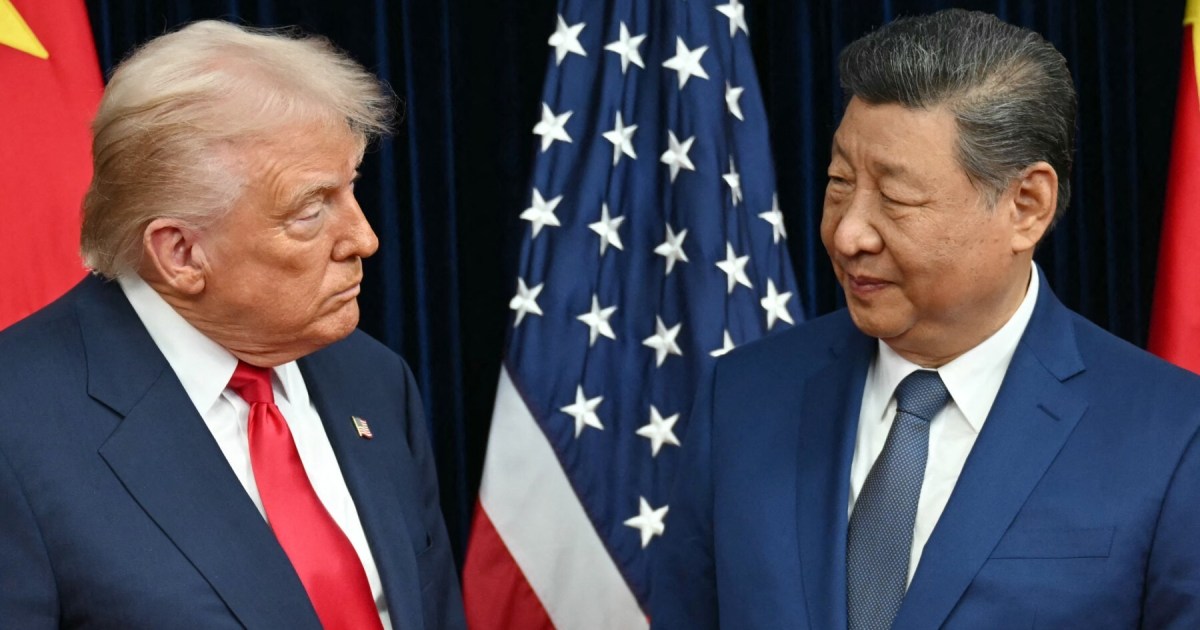

Taipei, Taiwan – Chinese President Xi Jinping is expected to seek concessions on Taiwan and US tariffs when he meets United States President Donald Trump for a high-stakes summit taking place in the shadow of the war on Iran.
Trump will arrive in China on Wednesday evening for a three-day visit that will mark the first trip by a US leader to the country since 2017, when Trump visited in the early days of his first term.
- list 1 of 4Starmer at risk because he pushed Labour to be ‘new Conservative Party’
- list 2 of 4Peru presidential candidate charged with financial crimes
- list 3 of 4FBI Director Kash Patel fires back at drinking allegations
- list 4 of 4Argentines protest against Milei’s defunding of public universities
end of list
Unlike Trump, who is renowned for his mercurial policymaking, Xi is widely seen as predictable in his goals for the summit, particularly as they concern Beijing’s longstanding “core interests” related to national security and territorial integrity.
At the top of that list is Taiwan.
While Taiwan’s government considers itself the head of a de facto sovereign state, Beijing views the island as an inalienable part of its territory.
The US formally cut ties with Taiwan – also known as the Republic of China – decades ago, but is committed to aiding the self-governing democracy’s defence under the 1979 Taiwan Relations Act.
Under the law, Washington has provided Taiwan with billions of dollars in arms and pursued cooperation in areas such as military training and intelligence sharing, which Beijing considers interference in its internal affairs.
The US government officially acknowledges that China views Taiwan as part of its territory, but does not express a stance on whether it agrees.
Washington is also intentionally vague about whether it would intervene to defend Taiwan if China sought to annex it by force.
Advertisement
In a call with US Secretary of State Marco Rubio last month, Chinese Foreign Minister Wang Yi made clear that Taiwan would be raised at the summit, describing the issue as “the biggest risk in the China-US relationship”, according to a Chinese readout of the call.
China’s embassy in Washington, DC, reiterated that message after Trump’s departure for the summit on Tuesday, naming Taiwan as the first of “four red lines” that “must not be challenged”.
While analysts say it is unlikely that the US will change its position on Taiwan due to Chinese pressure, Trump said this week that the summit’s agenda would include US arms sales to the island, raising questions about the future of a stalled multibillion-dollar arms deal.
The US Congress approved the arms package reportedly worth $14bn earlier this year, but the sale still requires Trump’s final approval.
Xi will use his meetings with Trump to “influence and potentially convince Trump to agree to scale back, if not completely suspend, sales to Taiwan,” William Yang, a Taipei-based analyst at the Crisis Group, told Al Jazeera.
If Trump were to make concessions on weapons sales to Taiwan, he would be breaking with a longstanding policy against consulting with Beijing that dates back to former US President Ronald Reagan.
Cancelling or watering down the deal would be a serious blow to Taiwanese President William Lai Ching-te, who is locked in an intense fight with the opposition over defence spending, Yang said.
“They are hoping to first influence Trump’s decision around this issue and potentially create a situation where it will be much harder for [Lai’s] government to request more special defensive spending in the future,” Yang said.
Restoring the US-China framework
Xi is also eager to smooth over US-China relations after a tumultuous 18 months that saw Trump launch a second trade war with the world’s second-largest economy, according to analysts.
The standoff saw each side roll out escalating tit-for-tat tariffs – briefly sending duties well above 100 percent – and other punitive measures, such as export controls, before Washington and Beijing hit pause in May.
During their last meeting in South Korea in October, Xi and Trump agreed to a one-year reprieve in their trade war, while keeping some trade measures in place, including certain tariffs and export controls.
Over the past month, the US has rolled out several rounds of new sanctions targeting Chinese firms, including refiners accused of buying Iranian oil and companies accused of helping Tehran obtain materials to build drones and missiles.
Advertisement
Earlier this month, Beijing issued a “prohibition order” directing firms to disregard the US sanctions on its oil refineries.
“Beijing wants predictability and certainty for the remainder of Trump’s term through January 2029, because Beijing needs to be able to plan its own economic policies,” Feng Chucheng, a founding partner of Beijing-based Hutong Research advisory, told Al Jazeera.
These policy considerations include understanding tariff levels the US will apply to China and its trade partners, Feng said.
Wang Wen, dean of the school for global leadership at Renmin University in Beijing, said China wishes to return to a relationship based on “peaceful coexistence, mutual respect, and win-win cooperation”.
“We hope that this meeting will bring the US policy towards China back to these three principles,” Wang told Al Jazeera.
The stakes are high for Beijing, where the view of Trump has shifted from a “predictable transactional counterpart” to a “more action-oriented and harder-to-restrain opponent,” Hung Pu-Chao, deputy executive director of the Center for Mainland China and Regional Development Research at Taiwan’s Tunghai University, told Al Jazeera.
Restoring the US-China relationship to a stable footing is one way to mitigate these risks, Hung said.
Rather than secure concessions, Hung said, China’s priority is “trying to adjust the current strategic position and negotiating pace that are unfavourable to it, and bring US-China interactions back into a framework that it can better control”.
At the summit, Xi is likely to agree to increase purchases of US agricultural exports and Boeing planes, Feng said, and could also back Trump’s plan to create a “Board of Trade” and a “Board of Investment” to oversee US-China economic ties.
But China is unlikely to make compromises on rare earths – a sector it dominates – unless the US makes major political concessions, Feng said.
Calling for dialogue on the war on Iran
The US-Israel war on Iran will loom large over the summit.
Although not a main player in the conflict, China has been hit by the economic fallout of the war and the shutdown of the Strait of Hormuz, through which one-fifth of global oil and natural gas supplies usually pass.
Beijing has called for negotiations and a comprehensive ceasefire since the start of the conflict, a message Xi is likely to reiterate in his talks with Trump, according to Jodie Wen, a postdoctoral fellow at the Center for International Security and Strategy at Tsinghua University in Beijing.
“Xi will talk about this issue with Donald Trump and say that we all know that the war has a huge impact on the world, on Asian countries and the US, so we must have dialogue,” Wen told Al Jazeera.
Trump said on Tuesday that he does not need China’s “help” resolving the war, though the White House has pressured Beijing to lean on Iran to reopen the strait.
Xi and his top diplomat, Wang, have met more than a dozen global leaders and high-level officials since the start of the war, playing a behind-the-scenes mediating role.
Advertisement
China has had a “comprehensive strategic partnership” with Iran since 2016, and buys more than 80 percent of its oil.
Wen, the postdoctoral fellow at Tsinghua University, said Xi is unlikely to agree to any involvement except as a mediator, which she described as consistent with China’s longstanding approach to global affairs.
“China’s foreign policy principle is non-intervention,” she said. “This is our principle.”
Related News

Two hantavirus cases confirmed, five more suspected on stranded cruise ship
French left-wing’s Melenchon says he will run for president in 2027

New Zealand court denies bid by mosque mass shooter to appeal conviction