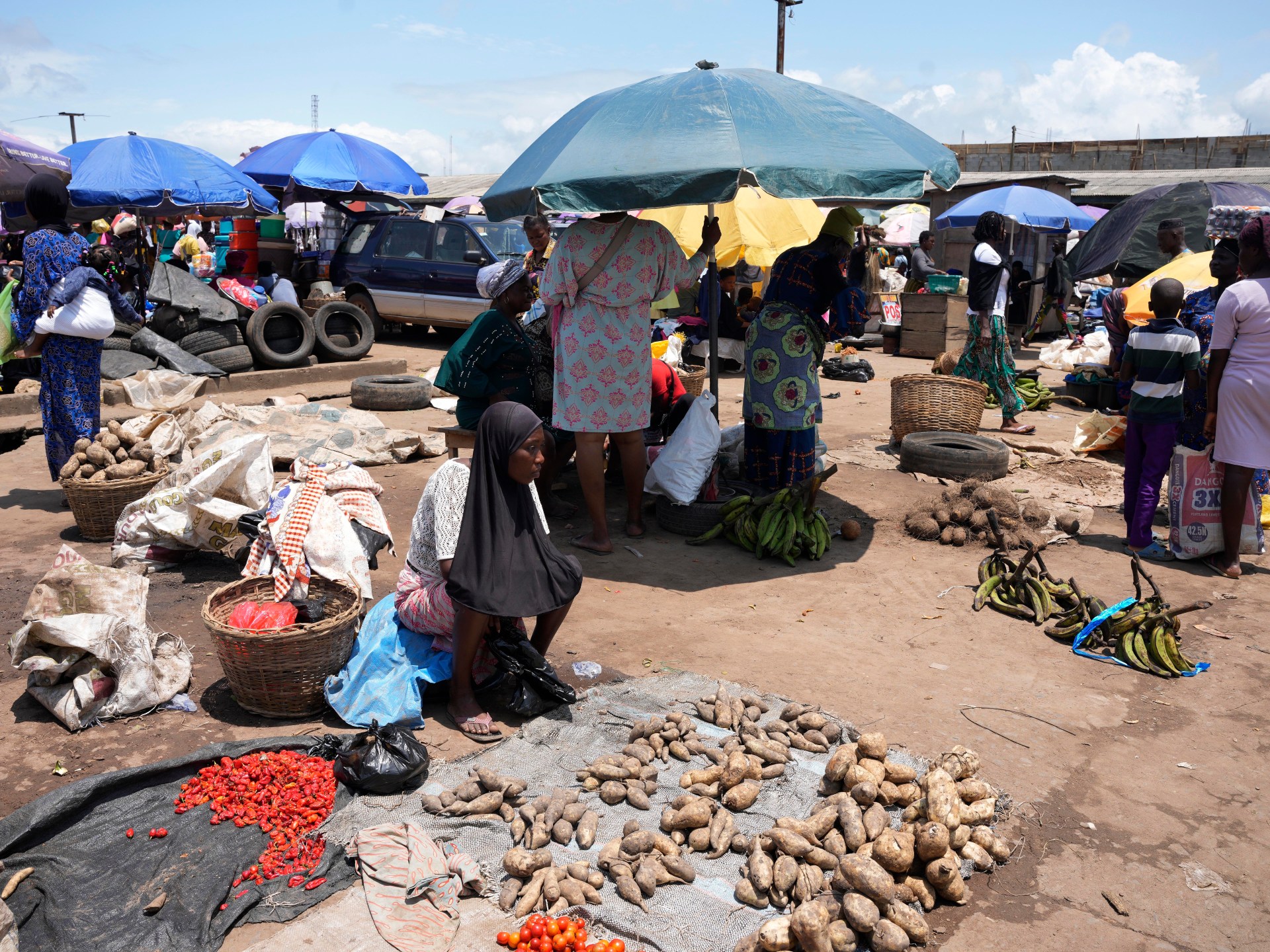

Lagos, Nigeria – Half an hour after Nurudeen Sanni and his crew began shooting a documentary in Ajah, several men surrounded them and demanded 100,000 naira (about $75) before they could continue filming.
As the crew negotiated, one of the men slapped a crew member who tried to protect the cameras. A scuffle broke out, and the men produced knives and cutlasses. The crew fled, but one member was stabbed in the neck and seriously injured, Sanni said.
“The painful part was that we saw a member of our crew being beaten and we could not do anything,” said Sanni, a 40-year-old sound recordist.
His experience illustrates the risks that filmmakers, content creators, photographers and journalists say they face while working on the streets of Lagos, Nigeria’s largest city and commercial hub.
Men locally known as agberos, a term commonly used for street touts, including some who collect levies from commercial transport operators, have been accused of demanding money from people filming in public and threatening those who refuse to pay.
In August, music video director ThankGod Omori, known professionally as TG Omori, described a night shoot in Ikoyi that was disrupted at about 3am by a crowd demanding money. He said he left the set in the hands of his assistant directors and security personnel, with one scene still unfinished. The following morning, he learned that the men had broken through a gate and injured a security guard who had refused them entry, according to Nigerian newspaper PUNCH.
Advertisement
Actress and content creator KieKie has also described being confronted by men after filming a short video in Obalende. She said they initially demanded one million naira (about $750), but she paid approximately 700,000 naira (about $525) after negotiations. For a separate shoot around Kara, near Berger, she said she spent close to 500,000 naira (about $375) on security.
Stanley Ikechukwu, an analyst at Lagos-based risk advisory firm SBM Intelligence, said creators regularly reported harassment and extortion. He described the situation as a “war on camera”.
Nabila Okino, an analyst at global risk advisory firm Africa Practice, said filmmakers were particularly vulnerable because abandoning a location could mean losing time and money.
“Because filmmakers often need to shoot in specific locations, those demanding money know that there is a cost to abandoning a location and starting again, which gives them leverage to extract cash,” she told Al Jazeera.
‘It creates self-censorship’
For journalists, the consequences extend beyond the cost of filming. Threats and harassment can prevent reporters from covering events and leave some communities and incidents underreported.
When Karina Adobaba-Harry covered the demolition of Makoko in January for News Central, the Nigerian television channel where she works as a camera operator, men in the area approached her crew and demanded money before they could film.

“That was funny to me because we are here to tell your story, you want the government to hear your voice … and you want us to still pay you. That sounded ridiculous to me,” she told Al Jazeera.
Adobaba-Harry said she regularly encountered men demanding payments while reporting. Some left when she explained that she had no money; others threatened to seize or damage her camera. She said reporters had sometimes paid out of their own pockets or used miscellaneous funds provided by their employer.
Ikechukwu said such incidents could affect what the public learns about events in the city.
“A reporter who is harassed or whose camera is seized while covering a flood, a fire, or a protest is not just being robbed, the public is being denied information. It creates self-censorship. Reporters will start avoiding certain areas, and the news will only come from ‘safe’ places,” he told Al Jazeera.
Advertisement
The cost of filming
For small production teams, unexpected payments add to the cost of camera rental, location fees, crew wages and transport. Some also budget for security or money they may be pressured to hand over after arriving at a location.
Adobaba-Harry said she had learned to change her demeanour when confronted by men demanding money.
“Sometimes, you have to take up the persona of the agbero so that when they see that you are not as calm, they will leave you,” she said.
She said many victims did not report incidents because they doubted that complaints would lead to action.

“Even if you report, chances that you will find the guys there [are] low. It is seen as a normal thing in Lagos, except if your life is in danger. But if it is just a case of wanting to take money from you, nobody will care,” she said.
Ikechukwu said the risk of being targeted had become another consideration for filmmakers planning a shoot.
“A filmmaker has to budget for ‘settlement’ on top of camera rental, location, crew, and food. It increases cost. It kills spontaneity; you cannot just see a beautiful Lagos moment and capture it. You have to think, ‘Will I be harassed?’” he said.
Okino said authorities should work with community leaders, market and park associations and other local groups to establish clear rules for filming in public spaces and ensure harassment and extortion are not tolerated.
‘Don’t bring your camera’
Foreign content creators documenting Lagos have also reported harassment. In September, Chinese travel content creator Xiao Jony shared a video of men confronting him while he was filming at a market in the city.
He said they demanded money and that, over a stretch of about 10 kilometres (6.2 miles), he encountered more than 20 checkpoints where people asked him for payment. It remains unclear who operated the checkpoints or whether they were linked to any government agency.
Okino said such experiences could discourage tourists and production companies from filming in Nigeria.
“They may decide that the cost and risk of producing content in Nigeria outweigh the benefits. At the margin, that could mean choosing neighbouring countries with more predictable and straightforward filming environments instead,” she said.

Ikechukwu said videos showing tourists being harassed could undermine efforts to promote Nigeria abroad.
“We tell the world, ‘Come to Lagos,’ but our own behaviour says, ‘Don’t bring your camera,’” he said.
Gbenga Omotosho, Lagos state’s commissioner for information and strategy, said nobody had the authority to demand money from people taking photographs or filming in public.
“If there are ruffians who are saying that before you can take a picture, before you can walk the street, you have to pay them money, that is not acceptable; that kind of case will be handled by the police, the government will not stand for that nonsense,” he told Al Jazeera.
Advertisement
For photojournalist Jean-Fidele E Ananou, the threats have changed how he documents Lagos. He used to go out daily to photograph what he describes as the beauty of the city. He has since stopped because of concerns for his safety and equipment.
“When you think about the whole thing, it just doesn’t make sense. When you see other people from other countries taking pictures of their country, it just makes you wonder why can’t it be the same here. It’s just a really crazy menace,” Ananou, 31, told Al Jazeera.
“For photojournalists and street photographers, it is getting increasingly difficult to tell stories,” he said.
Related News
Israel election 2026 live: Netanyahu faces tough test in high-stakes polls
US midterms 2026 live: Trump, Democrats make final push amid Michigan rift
Jailed PKK founder Ocalan moved to new section of Turkish island prison