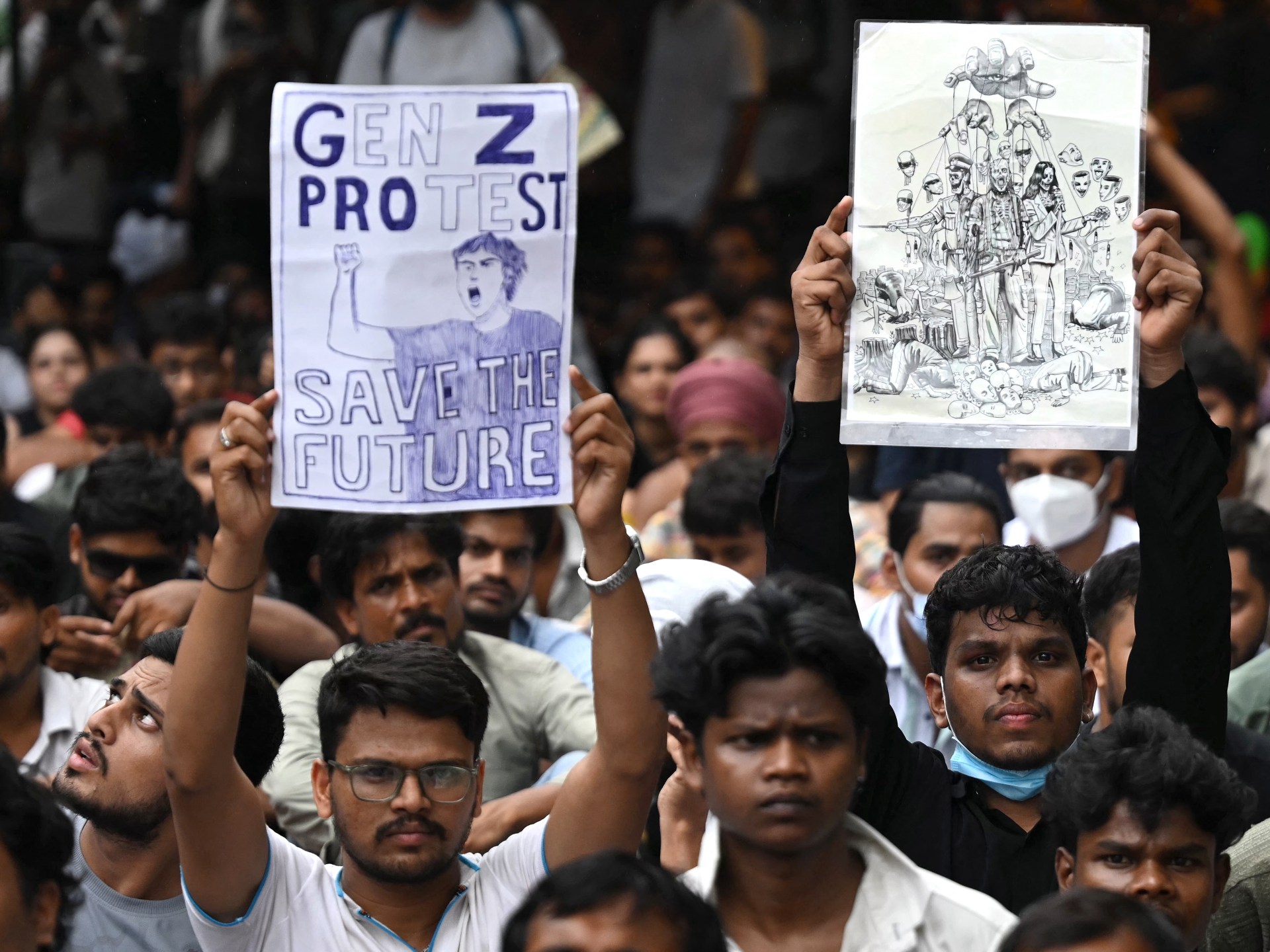

Leaders of the youth-led Cockroach Janta Party (CJP) have begun talks with India’s government to try and resolve a face-off over national examination paper leaks, although they will not halt nationwide protests, a spokesperson for the group says.
The talks between two senior government ministers and two leaders of the self-named CJP in New Delhi on Friday came hours after activist Sonam Wangchuk ended a 26-day hunger strike overnight.
- list 1 of 3Can India’s youth-led protest movement bring lasting change?
- list 2 of 3Indian activist Wangchuk ends 26-day hunger strike over exam paper leaks
- list 3 of 3‘Collapsed’: Roadblocks, internet blackout leave Pakistani Kashmir in limbo
end of list
The meeting has raised hopes that the two sides could be moving toward a breakthrough in the crisis in which tens of thousands of angry youth are demanding the resignation of the education minister over an exam paper leak scandal.
“We hope that the government comes with an open mind and it will listen to the people of this country who have been out on the roads for so long,” CJP’s spokesperson Saurav Das told reporters in New Delhi late on Thursday night.
“We will explain our demands to them in greater detail. And we hope that the government will listen to us.”
A senior Indian government minister said on Thursday that the government was always open to talks, for however long it would take, and that it would not “stand on prestige”.
The CJP is a political pressure group that has been leading the students’ protest. It says the demonstrations will continue “peacefully” until three demands are met: that Dharmendra Pradhan, the education minister, resigns; that the Modi government assures that no criminal cases will be pursued against protesters; and that compensation of about $105,000 be paid to families of students who died by suicide due to exam paper leaks and cancellations.
Advertisement
The protests are the biggest challenge to Prime Minister Narendra Modi since he came to power in 2014. Opposition parties have echoed the CJP movement’s demands and have disrupted the monsoon session of parliament that began this week.
India’s federal cabinet will also meet on Friday and discuss a draft to amend laws to punish culprits behind exam paper leaks and get it approved by parliament as soon as possible, Modi said in a social media video late on Thursday.
But the protesters have rejected the proposal, saying the examination system should be fixed to prevent leaks in the first place.
The nationwide protests will continue, CJP’s Das said. “We are not backing out. Because real awakening starts from the grassroots and that is what we really need.”
Anger across India
Over the past week, there has been anger on the streets of the capital, New Delhi, and other cities including Mumbai, Bengaluru and Patna, with thousands of young men and women stressing that they will continue to protest until the education minister resigns.
Vakil Yadav, a protester in New Delhi, told Al Jazeera he will continue to push for change, despite sustaining fractures to his hand during a police crackdown while they were marching to parliament this week
“There was nobody to stand with the students, speak out for them and raise their issue. Today we have that opportunity. So people from all across India are here,” Yadav said.
Sudesh Singh, another protester, told the Reuters news agency: “We will continue to protest till [Education Minister] Dharmendra Pradhan is terminated. He should not be given another position. If we stop here, then we will compromise the future of our children.”
The protests by the CJP began as an online satire and involved only a few hundred young people when they were first launched. But it grew to pull in millions of online followers after the cancellation of a national medical college entrance test in May, after the question paper was leaked, affecting about two million students.
Police violence and internet shutdowns
India’s police forces have tried to stop the protest movement.
On Monday, when tens of thousands of supporters of the movement marched towards India’s parliament, police pushed them back with tear gas and beat them with canes.
Violence was reported again on Wednesday night when more than 10,000 people gathered at the protest site in central Delhi.
Authorities in New Delhi have also shut 16 metro stations, mobile internet services and curtailed business in central Delhi where the protesters have been camped, seen as an attempt to curb the demonstrations, inconveniencing thousands of people.
Advertisement
The Delhi Metro Rail Corp said it was shutting down 17 stations again from early on Friday morning until further instructions, the third time this week it has resorted to such a large-scale closure of the system, which is the lifeline of the capital.
Related News
Italy suspends free movement with Spain: Is Schengen in crisis after Ceuta?
Iran to open ‘communication channel’ on MoU with US after talks in Qatar
Israeli drones strike Lebanon despite US-brokered framework deal