
Iraq’s government has struck dozens of agreements with Western oil companies, including to restore an energy supply route Baghdad could use to export its oil without the Strait of Hormuz.
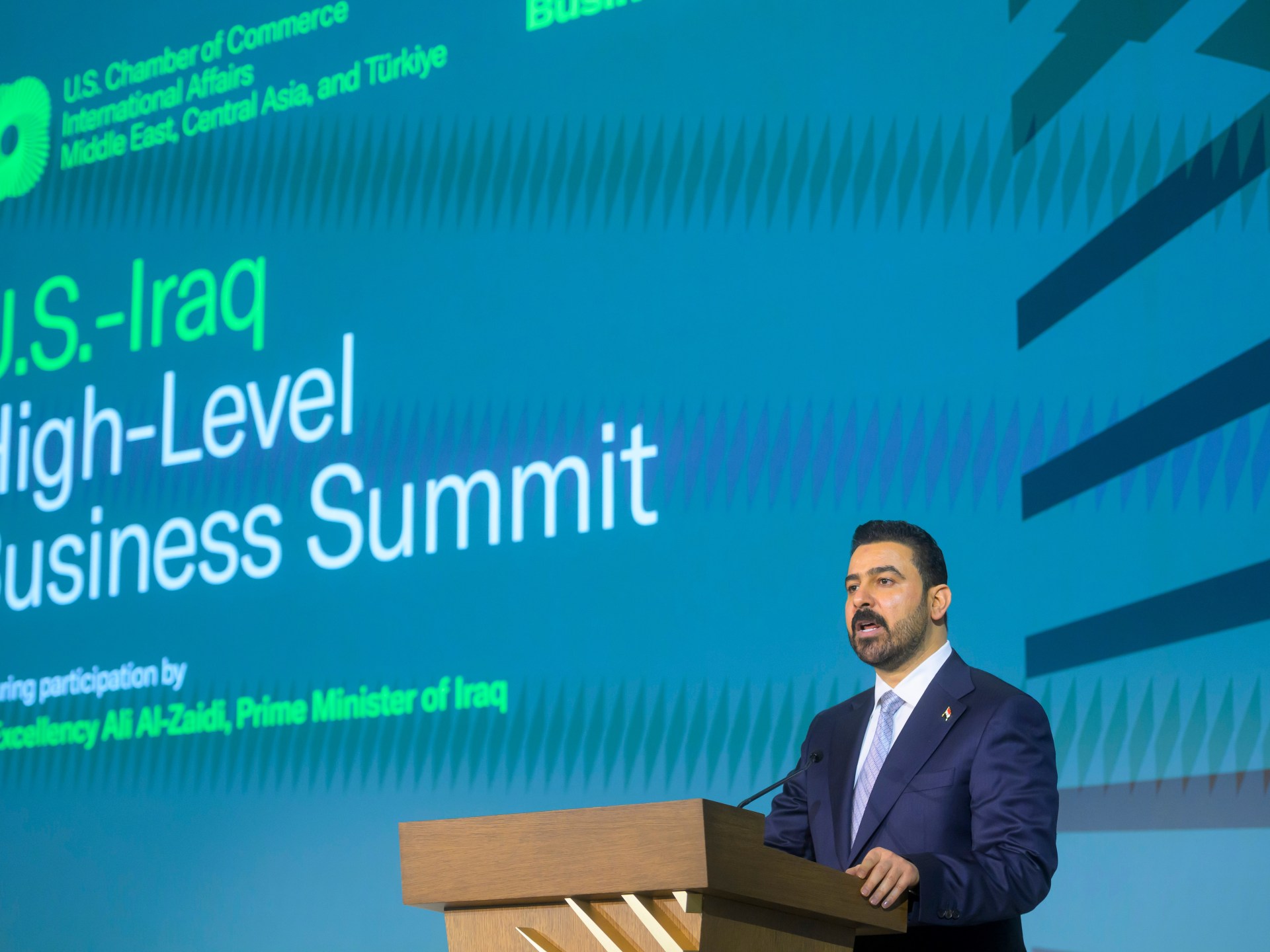
The preliminary deals, signed at a United States-Iraq business summit at the US Chamber of Commerce in Washington on Friday, come as Baghdad seeks to move away from dependence on the Strait of Hormuz, where transit has been heavily disrupted due to the US-Israel war against Iran.
- list 1 of 3Trump pivots from 20 percent Strait of Hormuz fee amid Iran war escalation
- list 2 of 3Why is the US attacking southern Iran’s civilian infrastructure?
- list 3 of 3Can the US and Iran reach a lasting deal to end the conflict?
end of list
Iraq and Syria signed a cooperation agreement to reconstruct the long-defunct Iraq-Syria crude oil pipeline, which runs from the oil-rich Kirkuk region in northern Iraq to Syria’s Mediterranean port of Baniyas.
Iraq’s state news agency reported that major US energy company Chevron would carry out the project under the agreement.
In a statement, the US Department of State said it welcomed Iraq and Syria’s plan to rehabilitate the pipeline, which it said a “US-led international consortium” would “execute the technical and financial aspects” of.
“Upon rehabilitation, this groundbreaking project will have an initial transport capacity of 2 million barrels per day of crude oil,” said the State Department. It called the pipeline “a critical energy corridor linking Iraqi oil production to Mediterranean export markets and beyond”.
US ambassador to Turkiye Tom Barrack said Iraq’s latest oil pipeline agreements would lead to a programme “that will make the Strait of Hormuz an afterthought”.
In addition to the Syria pipeline project, Chevron signed two other agreements with Iraq focused on boosting oil production, said the company’s president of corporate business development, Jake Spiering.
Advertisement
Iraq’s government also signed an official agreement with Starlink, owned by Elon Musk’s SpaceX, to operate formally in the country, reported Iraqi state media.
In total, Iraqi officials’ initial agreements with US firms, spanning the fields of energy, healthcare and technology, are worth more than $60bn, reported the Reuters news agency.
“We are using an open-door policy,” Iraqi Prime Minister Ali al-Zaidi said through a translator at the Washington summit. “Everybody who has a project can come and talk to us. We will not make it difficult for anyone.”
Related News

Can Sudan’s Rapid Support Forces take control of el-Obeid?

Why Israeli tenders for illegal E1 West Bank settlement prompted outrage
Former Emir of Qatar Sheikh Hamad bin Khalifa Al Thani dies: Reactions