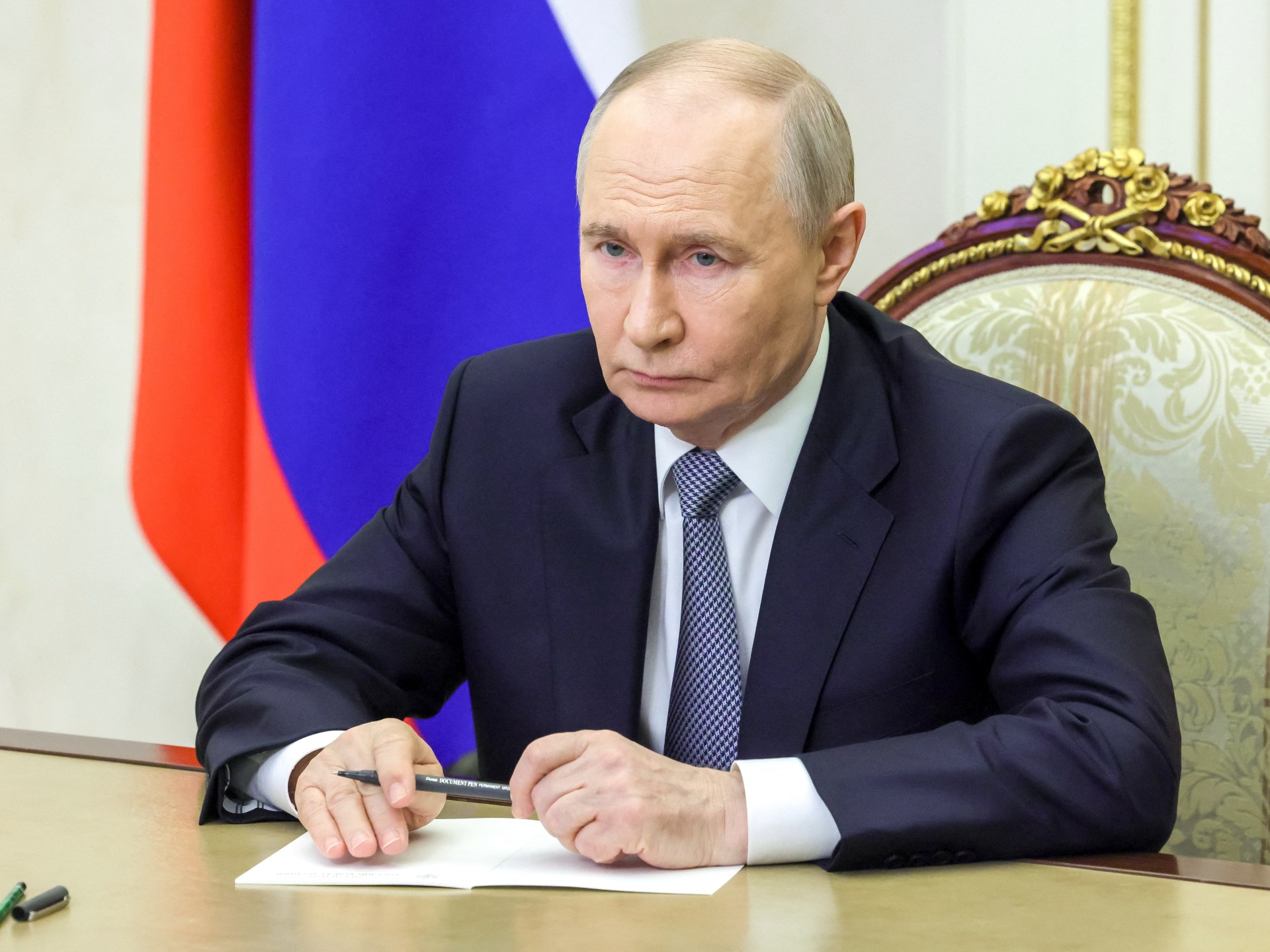

Russia has test-fired a new intercontinental ballistic missile, with President Vladimir Putin describing the nuclear-capable Sarmat weapon as the world’s “most powerful” missile.
State television broadcast footage of Sergei Karakayev, commander of Russia’s strategic missile forces, reporting to Putin on what Moscow described as a successful launch on Tuesday.
- list 1 of 4Ukraine hits Russia’s distant gas facilities after Moscow’s attacks kill 6
- list 2 of 4Serbia hosts first joint military exercise with NATO
- list 3 of 4Trump-Xi meeting: Could China, US form a ‘G2’?
- list 4 of 4Zelenskyy says Russia fired over 200 drones at Ukraine as truce expires
end of list
Putin said that the Sarmat missile would enter combat service at the end of the year.
“This is the most powerful missile in the world,” he said in televised remarks, adding that its warhead yield was more than four times greater than any Western equivalent.
Putin said the Sarmat was capable of suborbital flight, giving it a range exceeding 35,000km (21,750 miles), and claimed it could “penetrate all existing and future anti-missile defence systems”.
The test comes after years of setbacks.
Development of the Sarmat began in 2011, and before Tuesday, the missile had only one known successful test and reportedly suffered a massive explosion during an abortive test in 2024.
Designated “Satan II” in the West, the Sarmat is meant to replace about 40 Soviet-built Voyevoda missiles. Putin said on Tuesday that the Sarmat is as powerful as the Voyevoda but with higher precision.
The test came against a backdrop of concern over the collapse of the arms control architecture that governed the two United States and Russia’s nuclear arsenals for decades.
New START, the last remaining treaty between Russia and the US capping strategic warheads and delivery systems, expired in February, leaving the world’s two largest nuclear powers without any formal constraints for the first time in more than half a century.
Advertisement
Although Moscow and Washington agreed to resume high-level military dialogue after the treaty lapsed, there are no signs of progress towards a successor agreement.
Both sides have repeatedly accused the other of non-compliance with New START’s provisions.
US President Donald Trump has pushed for any new treaty to include China, whose arsenal is expanding but remains considerably smaller than those of Russia or the US.
Beijing has publicly rebuffed the pressure.
Trump had been largely silent on the question of extending New START before its expiry.
Putin, who came to power in 2000, has overseen efforts to upgrade the Soviet-built components of the Russian nuclear triad: deploying hundreds of new, land-based intercontinental ballistic missiles, commissioning new nuclear submarines and modernising nuclear-capable bombers.
He first unveiled the Sarmat in 2018 alongside a suite of new weapons systems that also include the Avangard hypersonic glide vehicle, capable of flying 27 times faster than the speed of sound.
The first vehicles have already entered service.
Russia has also commissioned the new nuclear-capable Oreshnik intermediate-range ballistic missile, and used its conventionally-armed version twice to strike Ukraine, where Moscow launched an invasion in 2022. Oreshnik’s range of up to 5,000km (3,100 miles) makes it capable of reaching any target in Europe.
Putin also announced that Russia was in the “final stages” of development of the nuclear-armed Poseidon underwater drone and the Burevestnik cruise missile, powered by miniature atomic reactors.
Putin has described those new weapons as part of Russia’s response to the US missile shield that Washington developed after its 2001 withdrawal from a Cold War-era US-Soviet Union pact that limited missile defences.
Russian military planners have feared that the US missile shield could tempt Washington to launch a first strike that would knock out most of Moscow’s nuclear arsenal, with the US then being able to intercept the small number of surviving Russian missiles fired in retaliation.
“We were forced to consider ensuring our strategic security in the face of the new reality and the need to maintain a strategic balance of power and parity,” Putin said.
Related News
At least nine people killed in explosion at Pakistan market
Follow the money: How far-right Reform UK built a global network
Does Trump hold ‘all the cards’ against Iran in the Strait of Hormuz?