Thai election sees old order restored as political dynasties weigh on vote
 13 February 2026
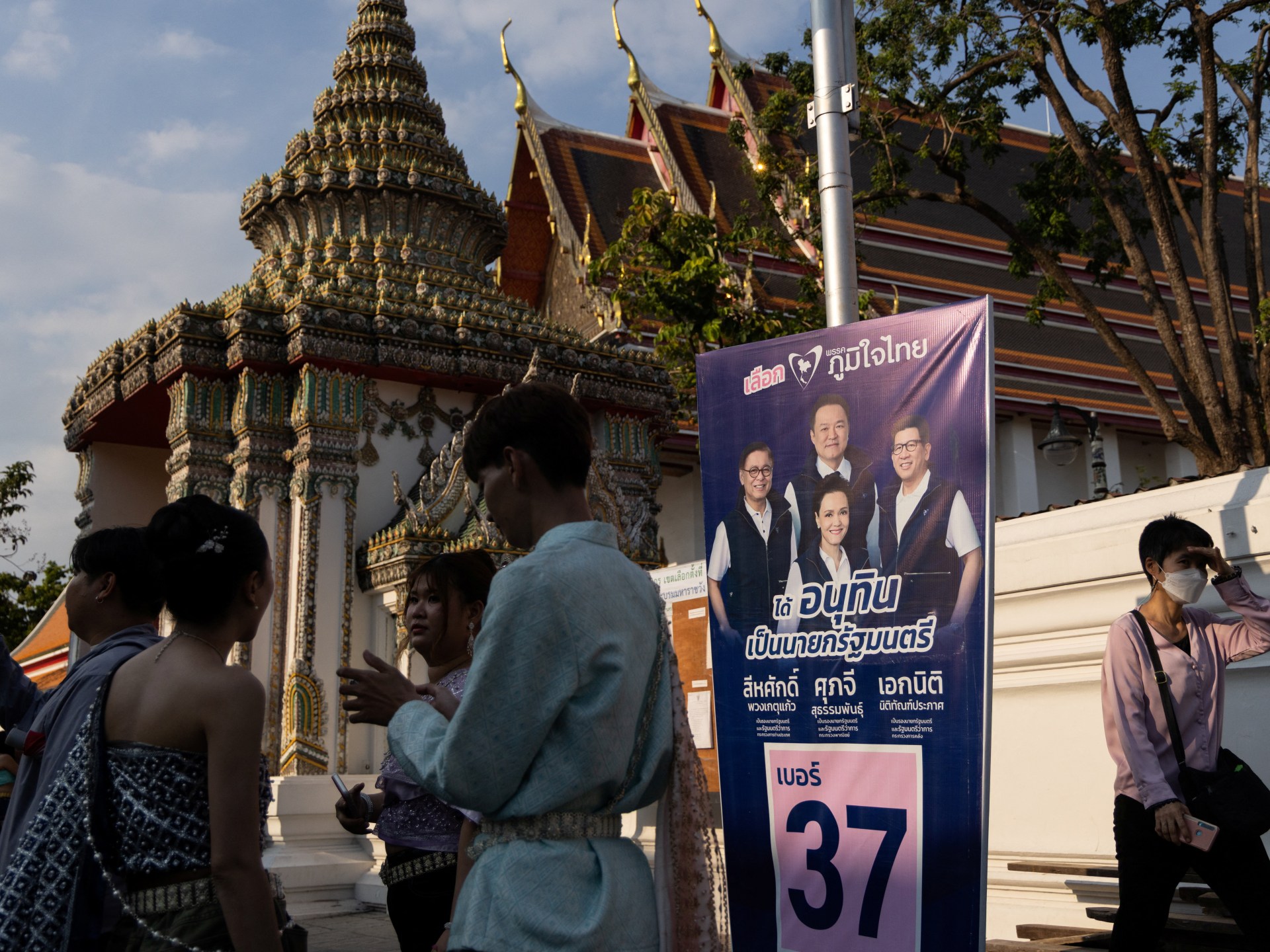

Bangkok – Thailand’s swing to more conservative politics in last weekend’s election reveals as much about the dynamics of local power brokers as it does the missteps of the main progressive party, which failed to get its message to stick outside of urban centres.
Anutin Charnvirakul, the leader of the Bhumjaithai Party, comfortably won Sunday’s election, according to an unofficial count by the Election Commission of Thailand (ECT), securing more than 190 of the 500 seats in Thailand’s parliament.
- list 1 of 4Will pro-military message bring Thailand’s ‘most hawkish’ party to power?
- list 2 of 4Thai PM Anutin’s party on course for victory in general election
- list 3 of 4Thailand’s Bhumjaithai set for coalition talks after surprise election win
- list 4 of 4Thailand’s PM Anutin claims victory in general election
end of list
While the ECT has 60 days to verify the results, Anutin is wasting no time.
On Tuesday, his attention had already turned to forming a coalition government with himself as prime minister, as his election rivals were left to pick through the ruins of their failed campaigns.
The youth-facing reformers in the People’s Party had been widely expected to secure the largest number of seats and the biggest share of the vote.
But they won just 118 seats, according to the ECT’s website, dozens fewer than the party secured in the 2023 election. The drop in support would seem to suggest that the public has turned away from the People’s Party’s call for structural reform in Thailand’s economy and politics.
Votes appear to have shifted to Anutin’s camp, an arch-nationalist who represents the interests of the country’s political and economic elite.
‘Baan Yai’ (Big Houses) politics
Though allegations of vote-buying and other polling irregularities in close constituency contests were growing, even the People’s Party leader, Nattaphong Ruengpanyawut, said it would not have been large enough to change the overall result.
Advertisement
Instead, a tearful Nattaphong apologised in a television interview to the party’s faithful and his members of parliament who lost their seats.
“I’m sad how the results turned out … but despite these tears, I’m committed to carrying on working for the people,” the 38-year-old said.
Analysts and political insiders told Al Jazeera that the People’s Party’s loss of voters – apart from urban areas in and around the capital, Bangkok, and the northern city of Chiang Mai – pointed to the deeper realities of Thai politics that continue to be insurmountable for reformists.
First among those obstacles is political patronage, experts say, where political support is based upon the promise of future favours.
Powerful political dynasties, called “Baan Yai” (Big Houses) in the Thai language, are entrenched across the country and particularly in Chonburi, Buriram and Sisaket provinces.
The “Baan Yai” joined forces under Anutin’s Bhumjaithai Party umbrella and brought along their followers to block out the People’s Party on election day.
“It’s been like this for a really long time,” said an aide to one of the most prominent of the political dynasties.
“In Bangkok, they think of their MPs as lawmakers, but we see them as village heads – someone who goes out and bats for you,” said the aide, who requested anonymity as he was not authorised to speak to the media.
“This is a person you see every day. This is the person who fixes your problems,” the aide added.
‘The only safety net they have’
Khemthong Tonsakulrungruang, a constitutional law scholar at Chulalongkorn University in Bangkok, said the People’s Party may have made a strategic mistake by neglecting “to combat the entrenched influence of Baan Yai” over local voters.
“Because resources are so scarce, rural populations do not view an MP as a representative in the civic sense … instead, they see them as a ‘clan leader’,” Khemthong explained.
“They remain tethered to this patronage system because it is effectively the only safety net they have,” he said.
Thailand’s last election in 2023 delivered a shock warning to some of those dynasties – in Chiang Mai and Chonburi – as younger voters could not be counted on to respect the influence of the Baan Yai at the polls.
That year, a so-called “orange wave” got behind the strong pro-democracy and reform message of the Move Forward Party – the People’s Party predecessor – after nine years of military rule by former army chief Prayut Chan-ocha.
Move Forward won that election, but it was promptly dissolved as a political party by the courts over its intention to reform the country’s draconian royal defamation laws, which protect Thailand’s powerful monarchy from criticism.
Advertisement
Move Forward rose from the ashes and came back as the People’s Party. But with its front-line leaders banned from politics, the movement struggled to reorganise across Thailand, another reason given for the party’s shortfall at the polls last weekend.
History also appears to be repeating.
Barely 24 hours after polling stations closed, Thailand’s National Anti-Corruption Commission (NACC) forwarded a petition to the Supreme Court seeking to ban 44 of the People’s Party Members of Parliament – including Natthaphong – from politics.
The Supreme Court’s decision could result in a lifetime ban for the progressive MPs – the latest legal blows to its momentum.
Nationalism also played a big part in Anutin’s win, particularly in the wake of the recent border war with neighbouring Cambodia.
Bhumjaithai cast itself as the party that got behind the military during the conflict and cast its political rivals as less able to protect the country.
Now, as election analysts assess the results, it appears that the return of the Baan Yai was the most crucial to Anutin’s decisive win, as old political power brokers consolidated under Bhumjaithai’s conservative credentials and refrained from splitting the vote share, which would have been advantageous to the progressive bloc.
“Voter turnout is at a historic low in the last 30 years, only 65 percent, according to the Election Commission,” said Prinya Thaewanarumitkul, a Thai politics expert and an academic at Thammasat University in Bangkok.
“When voter turnout is low, the ‘organised votes’ [mobilised supporters] and the influence of the ‘Baan Yais’ become the deciding factors,” he said.
Preliminary results show that Bhumjaithai made significant gains from central Thailand to the northeast, as well as the southernmost border area with Malaysia – many seats being won due to support from political families who expressed their support publicly for Anutin before the vote.
Beyond the drop in support for reformers and MPs losing their seats, the vote has left many Gen Z supporters at a loss as to why people did not choose to change Thailand for the better. They wonder why their countrymen appear to have thrown their support behind conservatism rather than change, especially when the poor are falling further behind the rich in Thailand’s slowing economy.
For People’s Party voter Arsikin Singthong, 22, who lives in Thailand’s southern Muslim-majority border province of Pattani, the reason can be found in money, politics and rural poverty.
“These Baan Yai politicians buy the poverty of rural people. This is the game,” Arsikin told Al Jazeera.
“But they can’t buy the urban population any more because we have already woken up,” she said.
The return of the political dynasties as power brokers reflects the systemic poverty still found in many parts of rural Thailand, analysts say.
The northeast, north and south lean towards political dynasties and populist promises in nearly all Thai elections, they say.
Advertisement
“The country is fundamentally split by resource allocation,” said Chulalongkorn University’s Khemthong.
“A younger generation has managed to break free from these patronage networks,” Khemthong said, referring to urban voters who form the People’s Party support base in Bangkok and elsewhere.
“They have the luxury of dissent because they have exited the system that still binds those left behind,” he added.
Related News
Venezuela’s National Assembly chief rules out new presidential election
Can Trump’s ‘madman theory’ reshape Iran and the Middle East?
Iran designates European armies ‘terrorist groups’ in retaliatory move