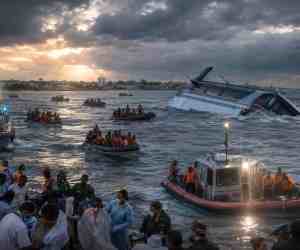


News Americas, GEORGETOWN, Guyana, Sun. July 26, 2026: With 73 bodies now confirmed and 30 more people still unaccounted for, Guyana’s MV Barima ferry disaster has become the deadliest maritime tragedy in the Caribbean since the August 1, 1970 sinking of the MV Christena off St. Kitts and Nevis – a disaster that claimed 233 lives and remains the worst in the region’s recorded history.

Guyana Prime Minister Mark Phillips has said that of the roughly 179 people believed to have been aboard when the MV Barima capsized off the Essequibo coast on July 19th, 76 have been rescued, and 73 bodies recovered, with 30 people still missing. Search and recovery operations, now in their second week, will continue “for as long as is necessary,” Phillips said, adding that the overturned vessel has not yet been righted and additional remains are expected once it is.
If even a fraction of the missing are confirmed dead, Guyana’s toll will surpass 100 – a number no other Caribbean maritime disaster has approached in more than half a century.

As comparisons between the two disasters have circulated online, a persistent claim has taken hold: that both ferries were built in Guyana. That’s only half true. The MV Christena was indeed built in Georgetown, then the capital of British Guiana, constructed by Sprostons Limited and completed in 1959 for the government of St. Christopher, Nevis and Anguilla. The MV Barima, however, was built roughly 4,300 miles away, in Port Glasgow, Scotland, by Ferguson Brothers, and completed in 1939 as one of three sister vessels — Pomeroon, Lady Northcote and Barima – ordered for British Guiana’s own Transport and Harbors Department.
So while Christena was Guyanese-built and later exported into service in St. Kitts and Nevis, the MV Barima was foreign-built but has spent its entire 87-year life in Guyanese waters. Both vessels, in other words, are woven into Guyana’s maritime history – just not in the way the online rumor suggests.
Beyond the builders, the vessels could hardly be more different. Christena was a compact 66 feet with a 16-foot beam and just 11 years old when it sank. the MV Barima, at 125 feet 9 inches and nearly twice Christena’s width, was 87 years old – one of the oldest passenger vessels still in active government service anywhere in the hemisphere.
Both, however, were acquired under colonial administration decades before independence – the MV Barima in 1939, 27 years before Guyana’s 1966 independence; the Christena in 1959, 24 years before St. Kitts and Nevis became independent in 1983. And both disasters share a chilling institutional thread: neither ship’s manifest reflected who was actually on board.
Guyanese authorities have confirmed that at least 35 of the Barima’s 67 initially rescued passengers weren’t listed on its official manifest of 116 passengers and 17 crew. Christena’s 1970 Commission of Inquiry similarly found no reliable system for counting passengers before departure, despite the vessel carrying more than double its rated capacity of roughly 150 when it went down.
Guyana’s government has ordered a multi-agency investigation into the Barima’s loading, manifest discrepancies, and crew conduct after the captain and first engineer, both in custody, tested positive for cannabis after their rescue. And the country’s President says an independent international Commission of Inquiry will be appointed to conduct a full investigation into the MV Barima tragedy even as his Prime Minister has said the MV Barima was not insured,
Twenty-two funerals have already taken place over the past three days, with more planned as families continue the heartbreaking task of burying their dead.
Fifty-six years after Christena forced the region to confront how little accountability existed for who boards a government ferry, Guyana is being asked the same question again.
Related News
A $647 Million US Caribbean Operation Has Killed 205 People And Congress Says It’s Not E...

The Caribbean Court Of Justice, And The Standard The Judiciary Must Meet
U.S. Says ‘Do Not Travel’ To Haiti – Then Prepares to Send 330,000 Haitians There An...