Trump to raise US global tariff from 10 to 15% after Supreme Court ruling
 21 February 2026
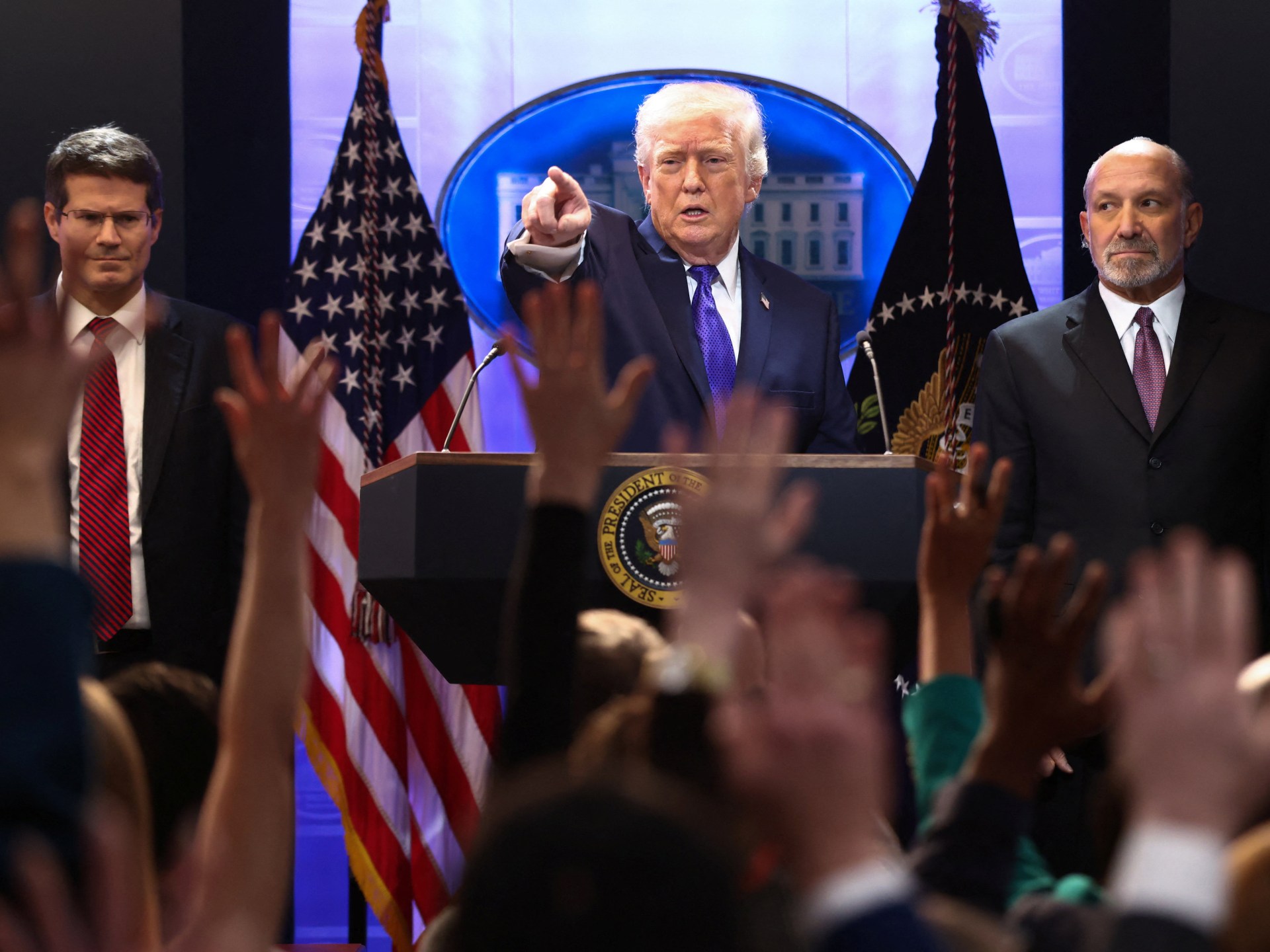

United States President Donald Trump has doubled down on his new global tariffs, raising them from 10 to 15 percent, after the Supreme Court invalidated his sweeping levies on imports.
The announcement on Saturday came as businesses and governments around the world sought repayment for the estimated $133bn that Washington has already collected.
- list 1 of 4Tariff refunds could take years amid US Supreme Court ruling, experts warn
- list 2 of 4Trump, JD Vance vilify ‘lawless’ Supreme Court justices over tariff ruling
- list 3 of 4World reacts as US top court limits Trump’s tariff powers
- list 4 of 4Trump’s tariff regime has been ruled unlawful. What are the implications?
end of list
“I, as President of the United States of America, will be, effective immediately, raising the 10% Worldwide Tariff on Countries, many of which have been ‘ripping’ the U.S. off for decades, without retribution (until I came along!), to the fully allowed, and legally tested, 15% level,” Trump wrote in a post on his Truth Social platform.
He said the move was “based on a thorough, detailed and complete review of the ridiculous, poorly written and extraordinarily anti-American decision” issued by the Supreme Court on Friday.
By a six-to-three vote, the court had ruled that it was unconstitutional for Trump to unilaterally set and change tariffs, because the power to tax lies with the US Congress.
The court’s decision struck down tariffs that Trump had imposed on nearly every country using an emergency powers law, known as the International Emergency Economic Powers Act (IEEPA).
Trump railed against the majority justices as “fools and lapdogs” in a news conference after the ruling, calling them an “embarrassment to their families”. He quickly signed an executive order – resting on a different statute, Section 122 of the Trade Act of 1974 – to impose the blanket 10 percent tariff, starting on Tuesday.
Advertisement
The 15 percent hike announced on Saturday is the highest rate allowed under the law.
However, those tariffs are limited to 150 days unless they are extended by Congress. No president has previously invoked Section 122, and its use could lead to further legal challenges.
It was not immediately clear whether an updated executive order was forthcoming.
Lawsuits
The White House said the Section 122 tariffs include exemptions for certain products, including critical minerals, metals and energy products, according to the Reuters news agency.
Trump wrote on Saturday that his administration will continue to work on issuing other permissible tariffs.
“During the next short number of months, the Trump Administration will determine and issue the new and legally permissible Tariffs, which will continue our extraordinarily successful process of Making America Great Again,” he said.
The president has already said his administration intends to rely on two other statutes that permit import taxes on specific products or countries based on investigations into national security or unfair trade practices.
Tariffs have been central to Trump’s economic policies, which he has said address a host of issues, from reviving manufacturing in the US to forcing other nations to action, whether it be stepping up efforts to combat drug trafficking or ceasing hostilities with each other.
He has also used the tariffs, or the threat of imposing them, to extract trade deals from foreign countries.
Federal data shows the Treasury had collected more than $133bn from the import taxes the president has imposed under the emergency powers law as of December.
Since the Supreme Court’s ruling, more than a thousand lawsuits have been filed by importers in the US to seek refunds, and more cases are on the way.
While legally sound, the path forward for such claims is not straightforward, especially for smaller firms, said John Diamond, director of the Center for Tax and Budget Policy at Rice University.
“It’s pretty clear that they will win in court, but it’ll take some time,” Diamond said. “Once we get the court orders in effect, I don’t think those refunds will be all that messy for larger firms. Smaller firms are going to have a much more difficult time getting through the process.”
But foreign governments are managing “the real mess”, Diamond said.
“What do you do if you’re Taiwan, or Great Britain, and you have this existing trade deal, but now it’s kind of been turned upside down?”
The US-Taiwan trade deal lowers the general tariff on Taiwanese goods from 20 percent to 15 percent, the same level as Asian trade partners South Korea and Japan, in exchange for Taipei agreeing to buy about $85bn of US energy, aircraft and equipment.
Advertisement
The US-United Kingdom deal imposes a 10 percent tariff on imports of most UK goods, and reduces higher tariffs on imports of UK cars, steel and aluminium.
‘Pickpocketing the American people’
After the Supreme Court’s decision, Trump’s trade representative, Jamieson Greer, told Fox News on Friday that those countries must honour their agreements even if they call for higher rates than the Section 122 tariffs.
Exports to the US from countries such as Malaysia and Cambodia would continue to be taxed at their negotiated rates of 19 percent, even though the universal rate is lower, Greer said. Indonesia’s chief negotiator for US tariffs, Airlangga Hartarto, said the trade deal between the countries that set US tariffs at 19 percent, which was signed on Friday, remains in force despite the court decision.
The ruling could spell good news for countries like Brazil, which has not negotiated a deal with Washington to lower its 40 percent tariff rate but could now see its tariff rate drop to 15 percent, at least temporarily.
Governments around the world have reacted to the Supreme Court decision – as well as Trump’s subsequent tariff announcement – with a mix of cautious optimism, trepidation and frustration.
German Chancellor Friedrich Merz said he would coordinate a joint European stance before talks with Trump in early March, while Hong Kong’s secretary for financial services and the Treasury, Christopher Hiu, described the situation surrounding Trump’s new tariff moves as a “fiasco”.
With the November midterm elections in the US looming, Trump’s approval rating on his handling of the economy has steadily declined during his year in office.
A Reuters/Ipsos poll that closed on Monday showed 34 percent of respondents saying they approved of Trump’s handling of the economy, while 57 percent said they did not approve.
Affordability remains a top concern for voters.
Democrats, who need to flip only three Republican-held seats in the US House of Representatives in November to win a majority, have blamed Trump’s tariffs for exacerbating the rising cost of living.
They were quick to condemn Trump’s new tariff threat on Saturday.
Democrats on the House Ways and Means Committee accused Trump of “pickpocketing the American people” with his newly announced higher tariff.
“A little over 24 hours after his tariffs were ruled illegal, he’s doing anything he can to make sure he can still jack up your costs,” they wrote on social media.
California Democratic Governor Gavin Newsom, a Trump nemesis, added that “he [Trump] does not care about you”.
Related News
Iran seeks to get out of FATF blacklist amid domestic political divisions

Russia-Ukraine war: List of key events, day 1,449
US Congress seeks answers, Maxwell invokes Fifth amid Epstein case tensions