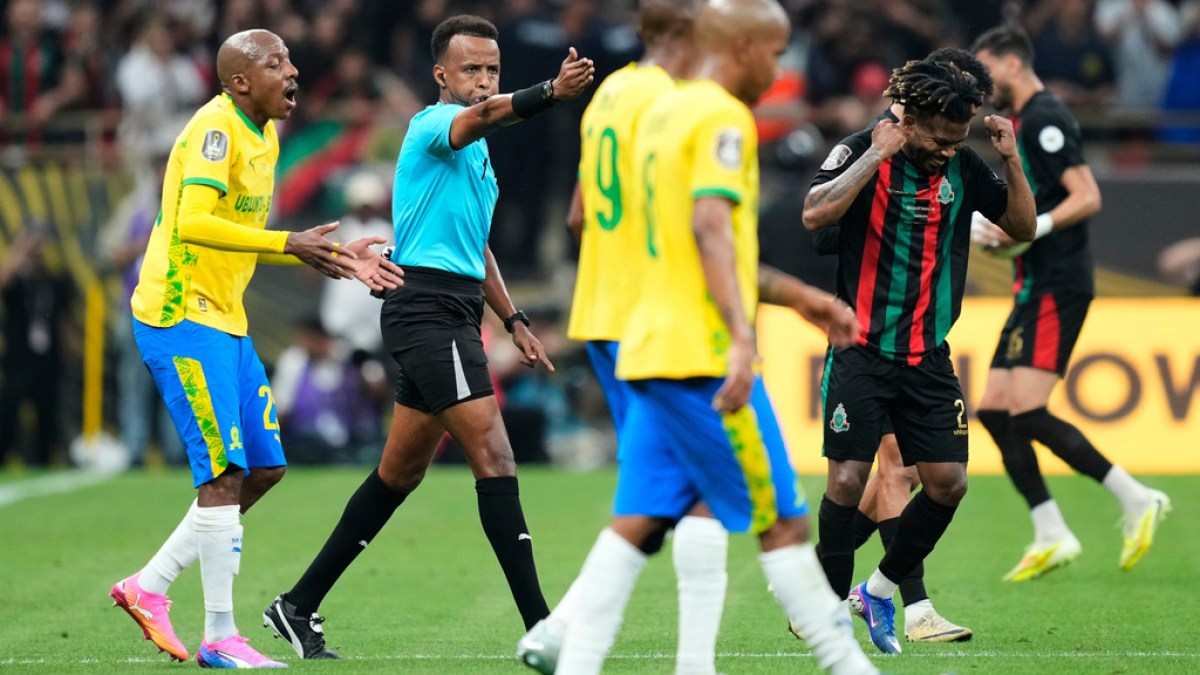

The United States has denied entry to a top Somali referee who was set to participate in the FIFA World Cup, raising concerns about Washington’s travel restrictions and their impact on the tournament.
The Department of Homeland Security (DHS) confirmed to Al Jazeera on Monday that Omar Artan was not allowed into the country after arriving in south Florida on Saturday.
- list 1 of 3The Take: FIFA World Cup – the politics and profits of the beautiful game
- list 2 of 3FIFA World Cup: the politics and profits of the beautiful game
- list 3 of 3Will the FIFA World Cup be the economic bonanza US cities were promised?
end of list
Artan, who is listed as one of FIFA’s 52 World Cup referees, was “determined to be inadmissible due to vetting concerns and was denied entry”, a DHS spokesperson said in an email, without providing further details.
Artan’s arrival in the US, however, suggests that he had a valid visa prior to travel.
Somalia is on President Donald Trump’s travel ban list. The president has often disparaged the African country and its people. Late last year, he sparked outrage when he called Somali immigrants in the US “garbage”.
Artan, one of Africa’s top referees, was set to become the first Somali to officiate a World Cup match.
The denial of entry is the latest controversy surrounding US travel policies and the World Cup, which is being co-hosted by Mexico and Canada.
Iran’s national team has to stay in Mexico due to visa issues. The players will be allowed to arrive in the US to play their game, but they must then return to their base south of the border. Still, some of the team’s staff members were denied US visas altogether.
There is also growing concern about federal agents harassing foreign nationals or targeting undocumented immigrants in or around stadiums.
Advertisement
On Monday, Zohran Mamdani, the mayor of New York, rebuked the Trump administration’s plans for a surge of Immigration and Customs Enforcement (ICE) agents in the city during the tournament.
His city is set to host fans for several matches, including the final, which will take place nearby in New Jersey.
“Soccer would not exist without immigrants. Immigrants play and coach the game, work in the stadiums, fill the stands, and make celebrations like the World Cup possible. Six of the players on the US Men’s National Team are immigrants,” Mamdani wrote in a social media post.
“We will not allow ICE or anyone else to sow fear in our communities — especially at this moment. As the world comes to our city, we will stand proudly with our immigrant neighbors and reject these attacks for what they are: an attempt to divide us.”
On Monday, the Council on American-Islamic Relations decried the US travel bans after Artan was denied entry.
“Our nation should not ban anyone from our shores simply because of their race or their ethnicity. That’s especially true of a coach or referee or anyone else coming to participate in the World Cup,” Edward Ahmed Mitchell, CAIR’s deputy director, told Al Jazeera.
“Somali visitors go to the same vetting process that other visitors go through, and once someone has gone through that thorough vetting process, there is no reason to ban them from our country simply because of their nationality. Doing so is an affront to our values and the law.”
FIFA, which awarded Trump its inaugural peace prize last year, did not immediately respond to Al Jazeera’s request for comment.
DHS has suggested that participation in the World Cup — including by athletes, coaches, and staff — does not affect inspection and decisions by Customs and Border Protection (CBP) at airports and border crossings.
“Admissibility determinations are made on a case-by-case basis using law enforcement, national security, and immigration information available at the time of inspection,” a DHS spokesperson said.
“CBP officers have the authority to question travelers, conduct inspections, and determine admissibility consistent with US law.”
Earlier this year, in an interview with Al Jazeera in Mogadishu, Artan said it was an “honour” to make an appearance on football’s brightest stage despite the hardships and civil strife in Somalia.
The referee added that, at times, he has had to change his route to his local stadium because of explosions in the country.
“You cannot give up as a referee. You have to have a target. I had this target, but it was not an easy job,” he said.
Advertisement
“You have to continue, and you have to fight if you want to go to a place like the World Cup.”
Related News

N Korea’s Kim Jong Un calls for ‘exponential’ expansion of nuclear arsenal
What Hegseth’s comments at Shangri-La Dialogue say about US foreign policy
Trump renews petition for White House ballroom, pointing to nearby shooting