
The Vatican has declared the Society of St Pius X (SSPX) to be formally in ‘schism’ with the Catholic Church after the traditionalist group defied Pope Leo XIV by consecrating four bishops without papal approval.
A schism is a formal break in the unity of the Catholic Church. It occurs when a person or group rejects the authority of the pope, whom Catholics believe is the successor to St Peter, one of Jesus’ 12 apostles.
end of list
In a decree issued on Thursday, the Vatican’s doctrinal office said the bishops involved, along with priests and lay members who knowingly adhere to the breakaway movement, had been excommunicated and no longer allowed to be members of the Church. It warned that the Swiss-based group’s celebration of the sacraments is now considered illicit and that it may no longer officiate marriages or hear confessions.
The non-approved consecrations mark the latest flashpoint in a decades-long dispute between the Vatican and the SSPX, which broke with Rome after rejecting many of the Catholic Church’s modernising reforms introduced by the Second Vatican Council.
Here is what we know:
What has happened and what is a consecration?
On Wednesday, the traditionalist Catholic group SSPX directly defied Pope Leo XIV by consecrating four new bishops without his papal consent.
In the Catholic Church, the act of consecrating a bishop is a deeply symbolic religious ritual which confers the Holy Spirit from one bishop to another.
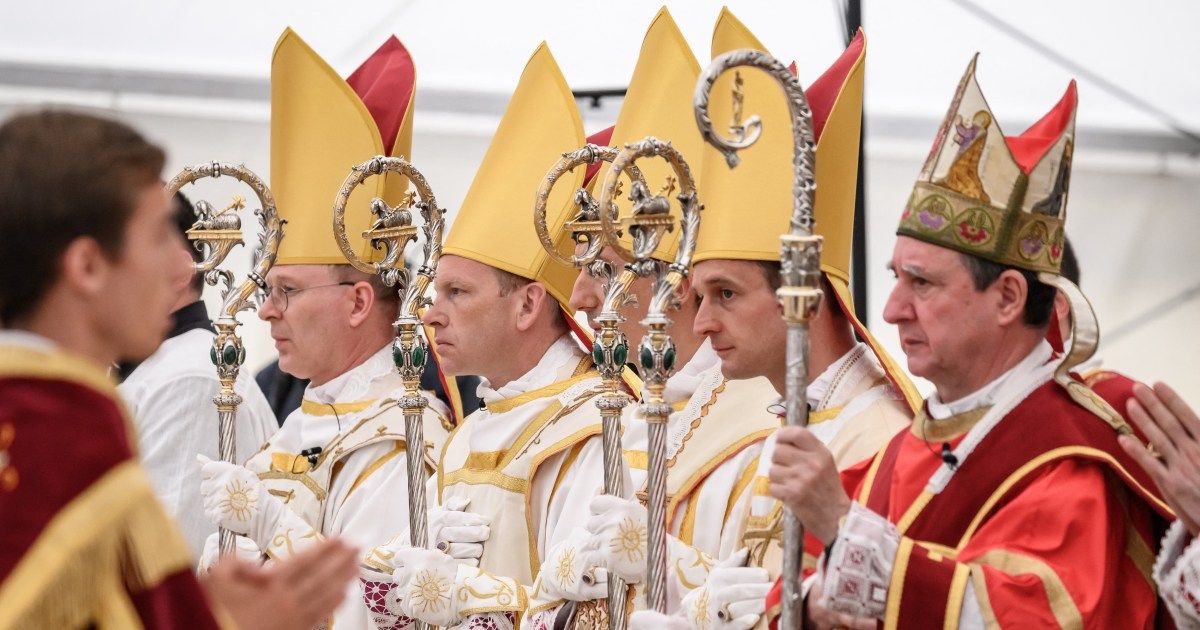
During the consecration rite, the presiding bishop physically places his hands on the heads of the new bishops, a gesture that recalls the actions of Jesus Christ towards his apostles. As part of the ceremony, the newly consecrated men also receive the traditional symbols of their new authority, which include mitre hats and pastoral staffs.
Advertisement
The five-hour ceremony was held at an SSPX seminary in Econe, Switzerland, attended by an estimated 16,500 faithful followers.

Despite a last-minute appeal from Pope Leo XIV, who warned in a letter on Tuesday that carrying out the consecrations without his approval would amount to a “sin of extreme gravity” that would ultimately harm the faithful, the group proceeded with the event.
During a Mass, Bishop Alfonso de Galarreta administered the consecration rite to four new bishops, Pascal Schreiber, Michael Goldade, Michel Poinsinet de Sivry and Marc Hanappier.
By participating in this ritual without a mandate from the pope, the new bishops and the consecrating bishop incurred automatic excommunication, which is the harshest penalty in the Catholic Church.
The SSPX dismissed the resulting penalties, with a priest reading a statement that justified the consecrations as a necessary “sacred duty” to defend the traditional Catholic faith against modernising reforms.

What is the Society of St Pius X (SSPX)?
SSPX is a traditionalist Catholic movement founded in 1970 by French Archbishop Marcel Lefebvre.
It was established in opposition to many of the reforms introduced by the Second Vatican Council (Vatican II), particularly the move away from the traditional Latin Mass and broader efforts to modernise the Church.
Today, the SSPX operates around the world with its own bishops, hundreds of priests, seminaries and religious communities. While it considers itself authentically Catholic, the Vatican has long maintained that it has no canonical status (officially recognised) within the Church.
In a sermon on Wednesday, the Reverend Davide Pagliarani, the society’s superior general, acknowledged that many would view the consecration as an act of rebellion.
“The greatest sacrifice that God can ask of us is that of being treated as rebels while we want to serve the church as a mother in difficulty, overwhelmed, suffering,” Father Pagliarani said.
What is the Second Vatican Council (Vatican II)?
The Second Vatican Council, commonly known as Vatican II, was a landmark gathering of Catholic bishops held between 1962 and 1965 which introduced sweeping reforms to help it engage better with the modern world.
Among its most significant changes were allowing Mass to be celebrated in local languages instead of exclusively in Latin, and improving relations with Jews, other Christian denominations and followers of other religions.
Advertisement
Pope Leo XIV has repeatedly described Vatican II as containing “fundamental elements” of Catholic teaching. The SSPX, however, rejects several of the council’s key reforms, arguing they depart from longstanding Church tradition.
The consecrations in Switzerland represent the most serious challenge to Pope Leo’s authority since his election last year and a major setback to his efforts to heal divisions within the Catholic Church.
What does excommunication mean in the Catholic Church?
Excommunication is the most severe penalty under Catholic canon law. The term derives from the Latin for “out of communion” with the Church.
It bars a Catholic from receiving sacraments, getting married or holding Church office, among other measures.
The Church considers excommunication a “medicinal” penalty. It is a temporary measure which can be lifted when the person at fault repents and asks for forgiveness.

Has this issue cropped up before?
Yes. The current crisis closely mirrors events of 1988.
That year, Archbishop Lefebvre, the founder of the SSPX, consecrated four bishops without the permission of Pope John Paul II. The Vatican declared the act schismatic and automatically excommunicated Lefebvre and the four new bishops.
One of them was Alfonso de Galarreta, who presided over Wednesday’s consecration ceremony in Switzerland.
In both cases, the SSPX deliberately consecrated bishops without papal approval to ensure the continuation of its leadership, despite Vatican opposition.
Although Pope Benedict XVI lifted the 1988 excommunications in 2009 to encourage dialogue, the SSPX never obtained legal status within the Catholic Church.
So, has the SSPX ever been part of the Catholic Church?
Not officially. The SSPX considers itself Catholic, but the Vatican says it has no canonical status within the Church.
Although the group has remained in an irregular relationship with Rome for decades, Pope Benedict XVI lifted the excommunications of its four bishops in 2009 in an attempt to encourage reconciliation. However, no final agreement restoring the SSPX to full communion was ever reached.
The gesture also became an acute embarrassment for him and sparked a crisis with Jewish leaders because one of the four – Bishop Richard Williamson – was a known Holocaust-denier.
In a television interview on Swiss TV just before the pope’s decree was made public in 2009, Williamson said he did not believe Jews were killed in gas chambers during World War II.
Benedict later acknowledged that he should have been more aware of this issue, agreeing that a simple internet search would have shown Williamson’s views.
Related News
Rescuers search for 18 missing after boat capsizes off Northern Cyprus

Cape Verde: All to know before FIFA World Cup knockout against Argentina
New Israeli assault in southern Syria forces families to flee their homes