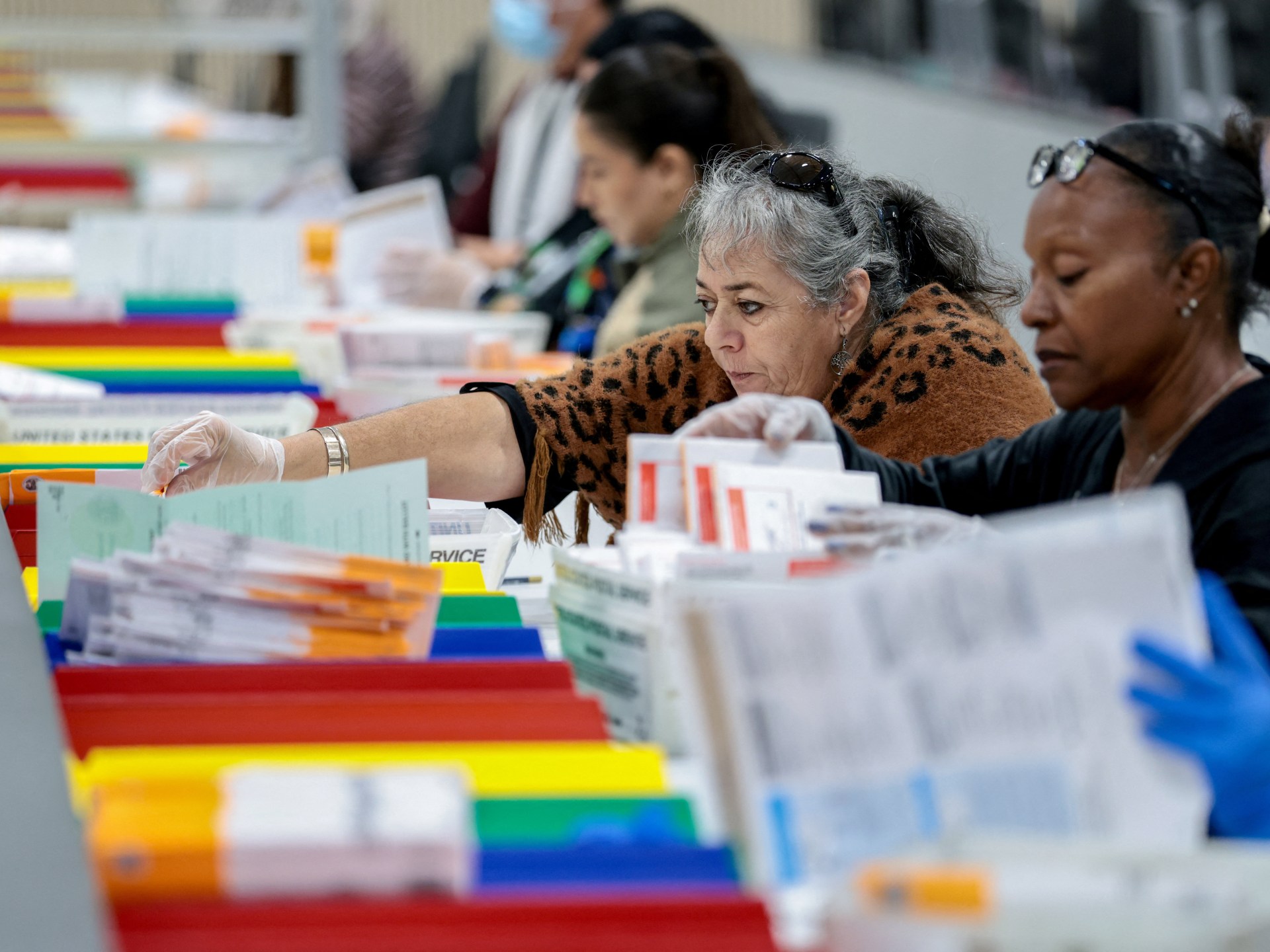

On Tuesday night, the United States – and many people around the world – will be following one of the country’s most closely contested midterm elections in recent years.
All 435 seats in the US House of Representatives and 35 of the 100 Senate seats are up for grabs as Democrats hope to take control of both chambers from President Donald Trump’s Republican Party.
- list 1 of 4How the president’s party has fared in every US midterm election since 1946
- list 2 of 4Trump, Vance campaign with candidates on last day before US midterms
- list 3 of 4US midterms 2026: What polls reveal about Democratic, Republican voters
- list 4 of 4Trump makes final midterms pitch at Lincoln Memorial Reflecting Pool
end of list
Here is what we know about the results:
When will the first results come in?
The first results should be known on Tuesday after polls begin to close. Voting will end first in some jurisdictions on the East Coast at 6pm (23:00 GMT).
Results will continue to come in throughout Tuesday evening, and some probably won’t be known until Wednesday or later in some races as more states finish voting and officials start releasing their vote counts.
But the first reported results won’t necessarily mean that a winner has been announced.
Election officials release vote counts as ballots are processed, and news organisations, like The Associated Press, then analyse them to determine how to call a race.
A closely contested race could take hours to call – or even days. It might not be clear for days whether the Republicans will retain control of Congress or Democrats secure a majority in either or both chambers.
The first polling stations to close will be in parts of Indiana and Kentucky.
- 6pm Eastern Standard Time (EST) (23:00 GMT) – parts of Indiana and Kentucky
- 7pm EST (00:00 GMT) – most of Florida, Georgia, South Carolina, Vermont, Virginia, and the remaining parts of Indiana, Kentucky and most of New Hampshire
- 7:30pm EST (00:30 GMT on Wednesday) – North Carolina, Ohio, West Virginia
- 8pm EST (01:00 GMT on Wednesday) – Alabama, Connecticut, Delaware, Illinois, Maine, Maryland, Massachusetts, Mississippi, Missouri, the remaining parts of New Hampshire, New Jersey, Oklahoma, Pennsylvania, Rhode Island, Tennessee, Washington, DC, and parts of Florida, Kansas, Michigan, North Dakota, South Dakota and Texas
- 8:30pm EST (01:30 GMT on Wednesday) – Arkansas
- 9pm EST (02:00 GMT on Wednesday) – Arizona, Colorado, Iowa, Louisiana, Minnesota, Nebraska, New Mexico, New York, Wisconsin, Wyoming, and the remaining parts of Kansas, Michigan, North Dakota, South Dakota and Texas
- 10pm EST (03:00 GMT on Wednesday) – Montana, Nevada, Utah, and parts of Idaho and Oregon
- 11pm EST (04:00 GMT on Wednesday) – California and Washington, and the remaining parts of Idaho and Oregon
- 12am EST (05:00 GMT on Wednesday) – Hawaii and most of Alaska
- 1am EST (06:00 GMT on Wednesday) – the remaining parts of Alaska, including the western Aleutian Islands
Advertisement
- Alaska: The state uses ranked-choice voting. If no candidate receives more than 50 percent of the vote, extra rounds of counting are needed to determine the winner. And while in-person early and Election Day voting are reported on election night, the mail-in voting results are released in the following days. In 2024, about 75 percent of the votes were counted by the morning after the election with the remaining votes reported over the following days.
- California: The state carries out elections primarily by mail. Large batches of ballots come in and are verified days after the polls close, so close House races can take days or weeks to resolve.
- Arizona: In some counties, voters drop off mail-in ballots on Election Day. These ballots must undergo signature checks before being counted, which can delay results by several days in close races.
- Nevada: All registered voters are mailed ballots. Mail-in ballots postmarked by Election Day can arrive up to four days later. Voters also have six days after Election Day to fix any signature problem, and this could delay results until the following week.
- Maine: Like Alaska, this state also uses ranked-choice voting. If no candidate receives more than 50 percent of the vote in a race with two candidates, ballots must be taken to Augusta, Maine’s capital, for further counting. This can delay final results.
- Washington: The state holds elections by mail. Ballots postmarked by Election Day can be counted in the following days, which can cause delays.
Some of the states that could report results earlier include:
- Florida: Votes are usually counted quickly. In the 2024 general election, about 99 percent of the votes were counted by 10:51pm EST (03:51 GMT the next day), according to The Associated Press news agency.
- Ohio: Ohio tends to release all or almost all of its early and absentee voting results in the first results. The first results of the 2024 elections were reported starting at 7:36pm EST (00:36 GMT), six minutes after polls closed. By 11:03pm EST (04:03 GMT), 90 percent of the results had been reported.
- North Carolina: This East Coast state is also expected to release most of its results from mail-in voting in the first update of the night. In 2024, the state reached 90 percent of vote reporting at 11:36pm EST (04:36 GMT).
- Pennsylvania: In 2024, the first results came in as polls closed at 8pm EST (01:00 GMT). Half of the votes had been reported by 10:12pm EST (03:12 GMT), rising to 90 percent by 12:48am EST (05:48 GMT) the next day.
- Wisconsin: In 2024, 90 percent of the state voting results were released by 2:22am (07:22 GMT) on November 6.
So when will we know who won?
Many races could be called on election night, but it might take several days to know which party will control the House and Senate in the final two years of Trump’s presidency.
Advertisement
If, for example, the US Senate race in Alaska requires a ranked-choice tabulation, the next round is scheduled for November 18.
So there is no specific deadline for knowing all the results. In races that are not close, news organisations are able to declare winners well before every ballot is counted while official certification takes place later. So quick reporting does not guarantee a fast race call.
In 2024, it took eight days to determine which party would control the House of Representatives.

What happens if results are challenged?
If a race is very close, a recount might be triggered automatically or if requested by a candidate, depending on state law.
Candidates also have the option of challenging the results in court, which could also delay the final result.
Trump has also raised questions about whether he would accept the midterm election results. When he was asked if he would respect the final outcome, he said; “I will if there are honest elections.”
But the US president cannot overturn congressional election results simply because he disagrees with them. Elections are administered and certified by individual states, and legal challenges must follow a process.
“All the states run elections. Courts accept that states run elections,” Democratic strategist Mali Smith told Al Jazeera.
Under the US Constitution, the House and Senate have the final authority to judge disputes over the elections of their own members.
Depending on the dispute, recounts and legal challenges could take days, weeks or longer to resolve.
Related News

Gaza doctors struggle with bereavement, overwork, trauma amid genocidal war

Trump faces bipartisan backlash over Russia sanctions waiver

Sullivan vows to honour Alaska race outcome, US judge dismisses DOJ lawsuit