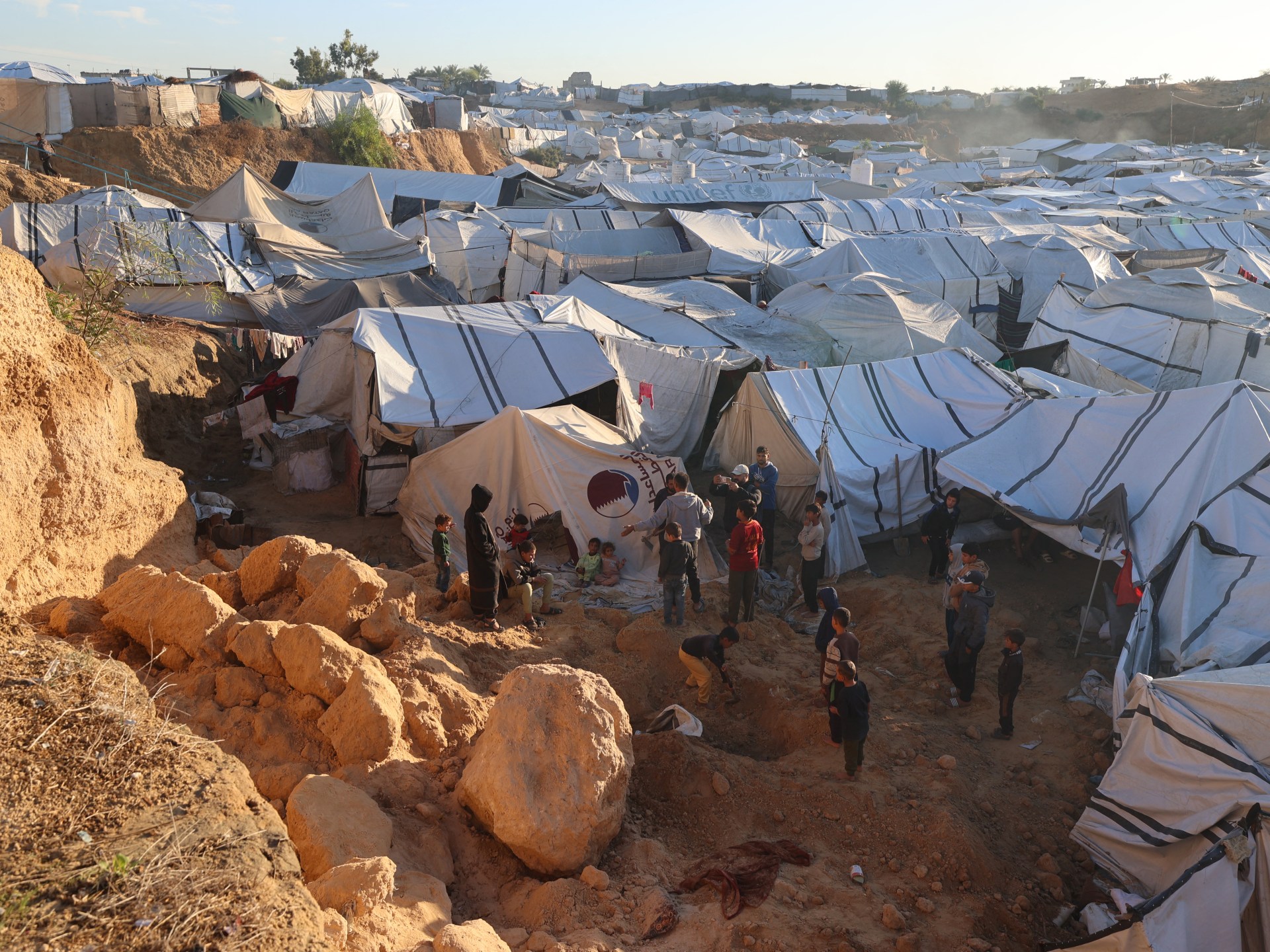

The first major storm of the season flooded about 70,000 tents in Gaza within 12 hours, killing at least five people and causing about $3m in damage, according to Gaza’s Government Media Office.
The storm hit over the weekend. By Monday, Gaza’s Civil Defence had logged more than 2,100 distress calls, warning that more than 2,000 buildings risk collapse. Nearly 400,000 displaced people shelter in areas judged highly vulnerable.
- list 1 of 3More than 100,000 sign petition for inquiry into UK role in Gaza genocide
- list 2 of 3How Israel’s separation wall compares with the Berlin Wall
- list 3 of 3What is next for Israel?
end of list
Israel is blocking 60,000 mobile homes and 200,000 tents, allowing only 20,000 tents into Gaza, where about 85 percent of homes have been destroyed or damaged by Israel’s three-year genocidal war.
Gaza’s Crossings and Borders Authority said Israel also let in no aid trucks or commercial goods on November 6 and 7; five trucks of cooking gas entered the next day. The UN’s Office for the Coordination of Humanitarian Affairs (OCHA) says Israel notified the UN on November 1 that it would suspend shipments from Egypt, and aid groups warn daily cooked meals could fall from about 600,000 to 330,000 as a result.
Gaza’s Ministry of Health says 20 more Palestinians were killed over the past week, bringing the toll since the October 2025 “ceasefire” to 1,613 as of November 9. Among them:
- Storm collapse, November 8: A sand embankment fell onto tents at a displacement site southwest of Deir el-Balah. Five bodies were recovered, among them Tahrir Nabhan and her daughter Maryam, and Habiba al-Zein.
- Strikes and shootings: On November 3, Rimas al-Madhoun, 16, was killed in a strike on a tent in Gaza City. Two days later, Noura Sheikh al-Eid was killed by tank fire in al-Mawasi hours after her daughter left for treatment in Egypt, and 12-year-old Adnan al-Qirnawi was shot and killed east of Bureij the same day. Nermin al-Amour and Mahmoud Abu Hammad were then killed on November 8 in a Khan Younis strike.
Advertisement
The weekend storm came as Hamas urged mediators and the Board of Peace not to link reconstruction to political or security conditions.
Arab-led parties at the table, and in the crosshairs
The political battle over Gaza’s future is unfolding as parties representing Palestinian citizens of Israel hold potentially decisive leverage in Israel’s post-election negotiations – amid an ongoing demonisation campaign against the parties and Arab voting power in Israel.
President Isaac Herzog gave opposition leader Gadi Eisenkot the mandate to form a government over the weekend after 67 members of parliament recommended him, against 46 for Prime Minister Benjamin Netanyahu.
Eisenkot wants a “national emergency government” open to any party accepting four principles, including recognition of Israel as a “Jewish and democratic” state, and Hamas as a “terrorist” group to be destroyed. For his part, Netanyahu gave a speech seeking a “national unity” government with Eisenkot, Likud, and his Haredi and far-right allies, warning that a government reliant on Arab-led parties would be backed by those who “want to eliminate Israel”.
One of the Arab-led blocs, the Joint List, has said its priority is to topple the Netanyahu government, but that it cannot join an administration that violates international law. It has also said it expects action on education, welfare and crime if it is to support Eisenkot from outside government.
In discussions with Herzog, Mansour Abbas, the leader of the other Arab-led party, the United Arab List (Ra’am), declined to call Hamas a “terror” group, citing fear for his family, while backing its disarmament, according to the Times of Israel. Avigdor Liberman, leader of the opposition Yisrael Beytenu party, repeated that no government should rely on either Palestinian-led party.
Beyond the rhetoric, journalist Abed Abou Shhadeh, a Palestinian citizen of Israel, was released without charge on November 8 after five days in the custody of the domestic intelligence agency, the Shin Bet, saying his arrest was meant “to intimidate Arab society as a whole”.
The Shin Bet chief sought to question leaders of the Palestinian-led parties, but Israel’s attorney general says the fraud probes would not “even remotely” change the result of the election. Tensions on the streets led to a far-right march through a Palestinian neighbourhood in the mixed city of al-Lyd (Lod) on the evening of November 8, which ended in a brawl and 11 arrests, according to the Times of Israel.
West Bank: Takeovers, seizures and a harvest under attack
On November 4, about 30 settlers backed by the settler group Nachala entered Ein a-Duyuk a-Tahta, near Jericho, and took over eight Palestinian homes. Peace Now, citing reports, said settlers shot a Palestinian man in the leg, and the UN said the army declared a closed military zone, blocking humanitarian access.
Advertisement
Settlers say they bought the homes through Nachala; Jericho Governor Hussein Hamayel called the sale a forgery.
For months, the state has backed settlers’ land razing and takeover efforts in the area, and that continued this week. The Jerusalem Post reported the alleged purchase was coordinated with the settler Binyamin Regional Council.
Haaretz reported that Central Command chief Major General Avi Bluth knew of the entry in advance and told the settlers not to alert senior officers until they were inside, with three army platoons diverted to protect the settlers during the takeover of houses; the army called the Haaretz report false.
But Jericho was only the most dramatic case of a multi-pronged escalation in which land seizures, demolitions, attacks and arrests unfolded in the West Bank, with settlers, soldiers and the Civil Administration often working in concert.
- Attacks on the olive harvest: OCHA counts 377 harvest-related attacks since September 1, more than any previous season. In October alone, OCHA documented 457 attacks causing casualties or damage in the West Bank, the most in any month since it began counting in 2006. In Burqa, northwest of Ramallah, settlers set olive groves on fire on November 5 while forces stopped residents from putting them out. Near Salfit, settlers beat three young men with clubs on November 8, and on November 9 they drove farmers off land near Silwad and injured one near Tayasir, according to Palestinian state news agency Wafa.
- Demolitions: On November 4, forces demolished 21 structures belonging to three families in the northern Jordan Valley and five homes in Biddu the next day. On November 9, according to Wafa, a 200-square-metre house, its well and fruit trees were razed in al-Hijra, near Dura.
- Sieges and closures: Settlers entered the sixth week of a nearly complete siege of Yusuf Shanaran’s home in Wadi al-Rakheem, according to Shanaran. According to village mayor Marwan Sabah, a similar settler siege continues of the Abayet family home in Umm Safa, which recently received demolition orders from the Israeli Civil Administration, despite it being built before Israel’s occupation began in 1967. In the south, forces closed Hebron’s Ibrahimi Mosque to Palestinians for two days during a Jewish holiday, days after the army ended a 10-day operation in the city.
Related News

Europe’s wealth gap: Older households eight times richer than young ones
Qatar’s Emir meets Iran’s Pezeshkian in Moscow
Iran war live: Iran says US ‘not serious’ about talks; ship ablaze off Iraq